Costs of selling a house in Switzerland, who pays what
Transfer duty is the buyer’s business, property gains tax is yours. Rates for the six French-speaking cantons, the Geneva scale by length of ownership and a worked example.
By the Envergure editorial team
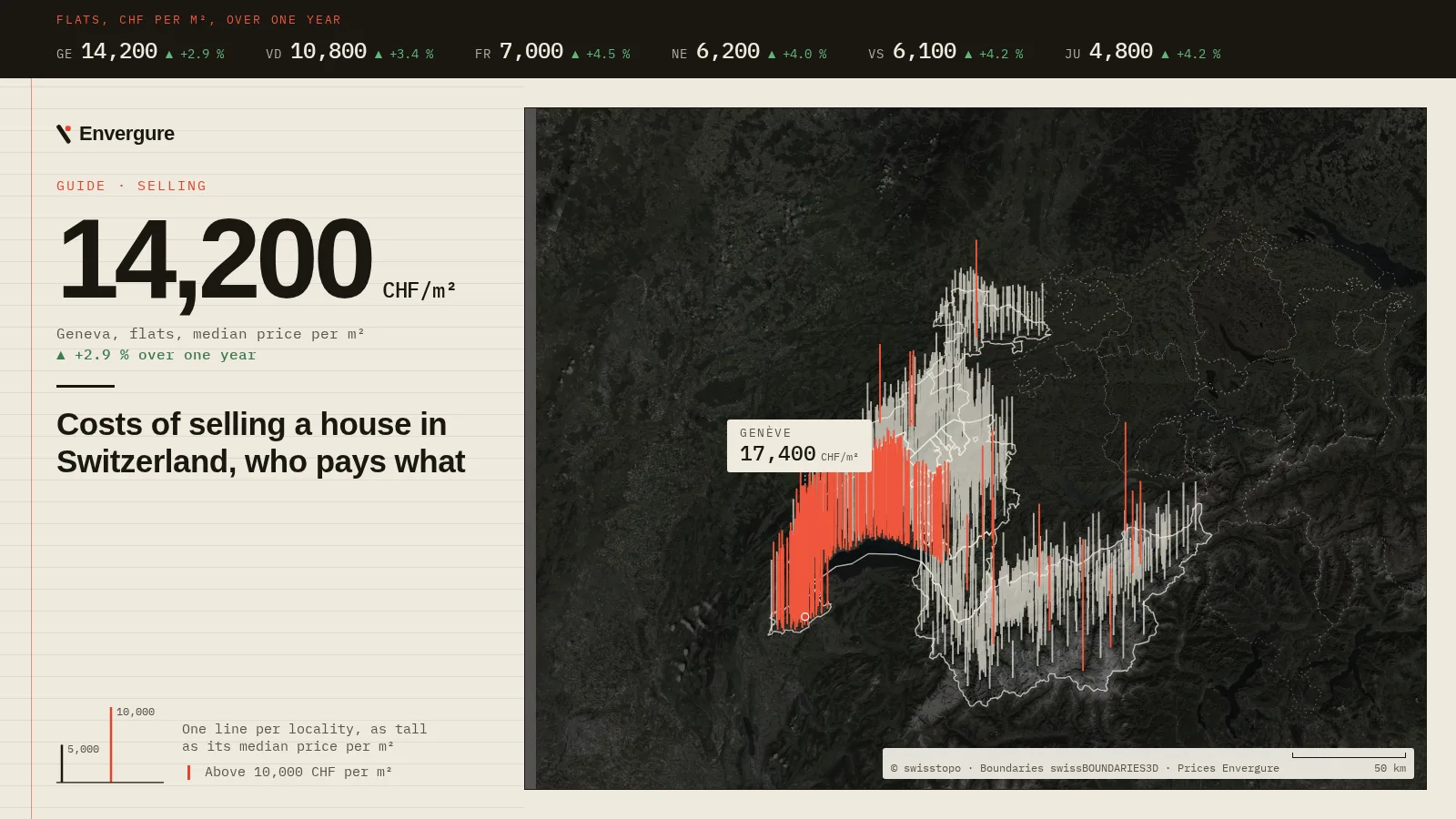
The costs of selling a house in Switzerland split in two. The buyer owes the cantonal transfer duty, 1% to 3.3% of the price depending on the canton. You, the seller, owe the property gains tax, and its rate falls with the length of ownership, from 50% down to 2% in Geneva.
Costs of selling a house in Switzerland, who pays what
The Confederation levies no transfer duty at all. The tax is cantonal, sometimes communal on top, and Schwyz is the only canton in the country that charges nothing (Federal Tax Administration, survey of November 2022).
Transfer duty taxes the transfer itself. It ignores your profit and looks only at the price, and as a rule the buyer owes it. Property gains tax is the other tax, the seller’s one, and it applies only to the gain you make. The two get confused, yet they share neither the same base nor the same debtor.
Two German-speaking cantons, Obwalden and Basel-Landschaft, split the transfer duty in half between seller and buyer. Geneva locks the opposite rule in place, where registration duties are borne by the new owner and no agreement to the contrary between the parties can be held against the tax authority (Geneva law on registration duties, art. 163).
Transfer duty canton by canton in French-speaking Switzerland
The rate depends on the canton. In three of these six cantons, Vaud, Fribourg and Valais, the commune adds its share on top of the cantonal duty. The figures below are the normal rates for a sale between unrelated parties.
| Canton | What the law says | Rate |
|---|---|---|
| GE Geneva | Registration duties on every deed of sale, owed by the buyer, no communal share | 3% |
| VD Vaud | 2.2% to the canton, communal supplement up to 50% of that rate, seller jointly liable | 2.2% to 3.3% |
| FR Fribourg | 1.5% to the canton, communal surcharges up to 100% of the cantonal tax | 1.5% to 3% |
| VS Valais | Rate banded by price, communal tax up to 50% of the cantonal duty | 1% to 1.5% |
| NE Neuchâtel | Normal rate, reduced rate if the buyer lives in the property for at least two years | 3.3% or 2.2% |
| JU Jura | Banded rate since 1 March 2024, owed by the buyer | 2.5% or 3.2% |
Position on 21 October 2026, from the Geneva law on registration duties, the Canton of Vaud, the Valais law on transfer duties, the Neuchâtel law on transfer duties, the Jura law, and the November 2022 survey by the Federal Tax Administration for Fribourg and the communal shares.
Property gains tax, the seller’s own bill
Article 12 of the federal law harmonising direct taxation requires every canton to tax the gain made on a privately held property, as soon as the proceeds of the sale exceed the investment outlay, meaning the acquisition price and the related costs. The same law requires cantons to tax quick resales more heavily, while leaving each one free to write its own scale and decide how fast it tapers.
In Geneva the gain is the sale value, the price less the agency commission, minus the purchase value, the price paid plus value-adding works. Maintenance costs do not enter the calculation (ge.ch).
| Length of ownership | Geneva rate |
|---|---|
| Under 2 years | 50% |
| 2 to 4 years | 40% |
| 4 to 6 years | 30% |
| 6 to 8 years | 20% |
| 8 to 10 years | 15% |
| 10 to 25 years | 10% |
| 25 years and over | 2% |
Geneva scale for the tax on property profits and gains, the 25-year band in force since 1 January 2025, ge.ch page updated on 21 April 2026.
Two situations push the tax back rather than cancel it. Replacement first, where you reinvest the proceeds of the home you lived in, within a reasonable period, in another property in Switzerland for your own use. Transmission next, by inheritance, advance against inheritance or gift. In both cases the tax waits for the following sale. If the scale costs you dearly today, the choice between selling and renting out looks different.
Agency commission and breaking your mortgage
No Swiss law sets what an agent may charge. In 2012 the Competition Commission put an end to the fee recommendations issued by USPI Neuchâtel for property management, with a penalty of 35,000 francs, and dropped the brokerage side of the case for lack of any appreciable effect on competition (COMCO). Your rate is therefore negotiated, and it belongs in the brokerage contract before the first viewing.
Leaving a fixed-rate mortgage early has a price too. The bank compares your contractual rate with the rate at which it can reinvest the money over a comparable term, multiplies the difference by the capital and by the years left to run, then adds its administrative costs. UBS gives the example of a 500,000 franc mortgage at 2%, reinvested at 1%, three years before maturity, which comes to around 15,000 francs.
The mortgage note is the certificate that pledges your property in the land register. Ask your bank for the exit statement before you announce a sale date.
What is left on a 900,000 franc sale
Example, a house in Geneva sold after nine years
- Sale price
- 900,000 CHF
- Agency commission agreed
- 27,000 CHF
- Sale value used for the tax
- 873,000 CHF
- Purchase value, the price paid plus the duties paid then
- 665,000 CHF
- Taxable gain
- 208,000 CHF
- Gains tax, 15% at nine years of ownership
- 31,200 CHF
- What you keep
- 841,800 CHF
Assumptions behind the example, bought for 650,000 francs nine years ago plus 15,000 francs of registration duties paid then, no value-adding works, no mortgage to break, Geneva scale in force. The 3% duty on the sale falls on the buyer and is not part of this calculation.
It all starts with the price your property can reach. Begin with a valuation, then set it against the levels of the Geneva market.
The steps, in order
- Price the property Start from a market value you can defend. Tax and commission are both worked out as a percentage of that price, and our guide on what your house is worth explains how to get there.
- Rebuild your purchase value Find the purchase deed, the duties you paid at the time and the invoices for value-adding works. Every franc you can prove cuts the taxable gain.
- Work out the gains tax Apply your canton’s scale to the exact length of ownership. Geneva moves in two-year bands, so the signing date changes the amount.
- Ask your bank for the statement Have the early repayment penalty quoted, and note the date on which it drops to zero.
- Put the commission in writing No legal tariff applies. The rate, the basis of calculation and the moment the commission falls due all belong in the brokerage contract.
- Check who pays at the notary Transfer duty is in principle the buyer’s business, but in some cantons you remain jointly liable for it. Read that clause before you sign.
- Purchase deed and the statement of duties paid on acquisition
- Invoices for value-adding works, filed apart from maintenance invoices
- Early repayment statement from the bank
- Signed brokerage contract, with the rate and the basis of calculation
- Land register extract and the position of the mortgage note
The traps to know before you sign
Frequently asked questions
What are the costs of selling a house in Switzerland?
The notary bill brings together the deed, the land register entry and the cantonal transfer duty, 1% to 3.3% of the price depending on the canton. That duty is owed by the buyer in the six French-speaking cantons. As the seller you pay the property gains tax and, if you use an agency, the commission.
Who pays the transfer duty, the buyer or the seller?
The buyer, in all six French-speaking cantons. Two German-speaking cantons, Obwalden and Basel-Landschaft, split it in half between the parties. In Geneva no agreement to the contrary can be held against the tax authority, and in Vaud and Valais the seller stays jointly liable for payment.
How is property gains tax calculated?
On the difference between the sale value and the purchase value. In Geneva the sale value is the price less the agency commission, and the purchase value is the price paid plus value-adding works. The rate then depends on the length of ownership, 50% within two years, 15% between eight and ten years, 2% from twenty-five years.
Can you avoid property gains tax in Switzerland?
No, but you can defer it. Taxation is postponed if you reinvest the proceeds of the home you lived in, within a reasonable period, in another property in Switzerland serving the same purpose. It is also deferred on inheritance, an advance against inheritance or a gift. The tax is not written off, it waits for the next sale.
Which renovation costs reduce the taxable gain?
Those that lastingly raise the value of the property. In Geneva they are added to the purchase value and so reduce the gain, while maintenance costs are excluded. File the invoices separately from the start of the works, they are worth money on the day you sell.
How much does it cost to break a fixed-rate mortgage?
It depends on the rate gap and the time left to run. The bank compares your contractual rate with the reinvestment rate for a comparable term, then multiplies the difference by the capital and the remaining years. UBS cites a 500,000 franc mortgage at 2%, reinvested at 1%, three years before maturity, which comes to around 15,000 francs.
Which Swiss canton charges no transfer duty?
Schwyz, the only one in the country. Everywhere else the duty is cantonal, sometimes topped up by the commune, and the Confederation levies none. The Federal Tax Administration survey gives the position canton by canton.
What has changed
- 24 October 2026 Guide rewritten to the new template, with verified transfer duty rates for the six French-speaking cantons, the Geneva gains tax scale by length of ownership, a worked example and a clear split between the buyer’s tax and the seller’s.