Building permit in Switzerland, timelines and costs
Thirty days in Geneva on the fast-track procedure, up to four months in Zurich for a new build. The deadlines, the exempt works and the full timeline of a permit, canton by canton.
By the Envergure editorial team
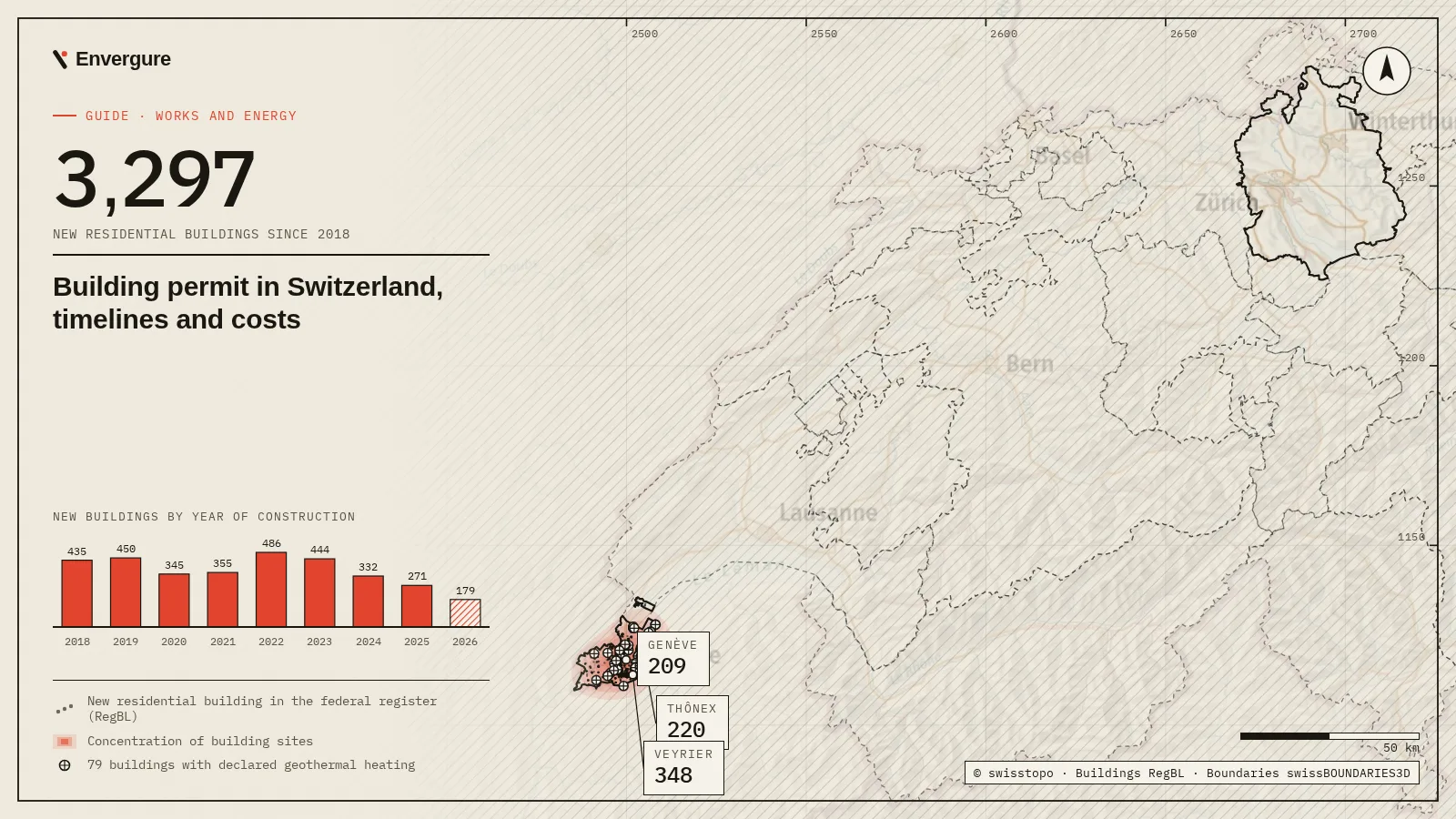
A building permit in Switzerland comes from article 22 of the Spatial Planning Act, which makes every new or altered construction subject to authorisation. Each canton then sets its own procedure, deadlines and list of exempt works. Geneva answers within 30 days on the fast-track procedure, Zurich within two to four months.
Building permit in Switzerland, what federal law requires
One federal sentence governs everything else. Article 22 of the Spatial Planning Act states that no construction or installation may be created or altered without authorisation from the competent authority. That law, known as the LAT, has organised land use since 1979.
Two conditions come with the principle. The project must match the zoning of the plot, meaning the plan that says what may be built there. And the land must be serviced, in other words connected to the roads and networks it needs.
Everything else belongs to the cantons. Federal law expressly reserves the other requirements of federal and cantonal law. Each canton writes its own building act, with its own procedures, deadlines and exemption lists. The same conservatory takes a different route in Geneva, in Lausanne and in Zurich.
Your nationality changes nothing here. The duty to obtain a building permit applies to every owner, Swiss or foreign. Buying the property is a separate matter, governed by the federal act on the acquisition of real estate by persons abroad, the lex Koller, which requires a separate authorisation. Our guide on buying property in Switzerland as a foreigner sets out those rules. A tightening of that act is at draft stage, with no date in force.
Pergola, garden shed, solar panels, the works that need no permit
Geneva publishes a list of constructions deemed of very little importance, exempt from authorisation inside the building zone. It covers removable sheds of around 5 m2 on the ground and 2 m high, uncovered pergolas, satellite dishes of 90 cm across for a private owner and 130 cm for an apartment building, and sloping roof lights under 1 m2 in the fifth zone. Heritage protection still applies in every one of those cases (article 1 of the Geneva building act).
Solar follows a federal rule that holds everywhere. A sufficiently adapted solar installation on a roof has been exempt from authorisation since 1 July 2022. Since 1 January 2026 the exemption also covers well integrated façade installations, provided you notify the municipality 30 days before work starts.
Fribourg spells out what sufficiently adapted means on a roof. On a pitched roof, the installation must not rise above the roof line seen from above and must form a single grouped block. On a flat roof, it stays under 1 metre above the upper edge and out of sight from the ground at a 45 degree angle (Fribourg guidance). A protected building sits outside all of this and still needs a permit.
Zurich has a fast lane of its own. A small project with no third party interest goes through a 30 day notification procedure. Solar panels, heat pumps and charging points may be installed 30 days after the acknowledgement of receipt, if no contrary decision is issued in the meantime.
Vaud lightens the public enquiry rather than the permit. A municipality may exempt a minor project from public enquiry, an uncovered swimming pool, a shed or a two car garage. The permit itself is still required. Market levels in that canton are on our Vaud valuation page.
How long a building permit takes, canton by canton
The table gives, for each canton, the rule its administration publishes and the figure that concerns you first. Deadlines are not counted the same way everywhere, Geneva starts from the registration of the application, Zurich from the preliminary check of the file.
| Canton | What the canton sets | Published deadline |
|---|---|---|
| GE Geneva | Decision within 30 days on the fast-track procedure, 60 days for a full application. The permit lapses after two years without work, with two one-year extensions possible | 30 to 60 days |
| VD Vaud | Filed with the municipality, single cantonal report through the CAMAC clearing office, then public enquiry and an appeal window of the same length | 30 + 30 days |
| FR Fribourg | A well integrated solar installation needs no permit, façades included since 1 January 2026, subject to prior notice to the municipality | 30 days notice |
| VS Valais | Own cantonal rule, check with the canton | check locally |
| NE Neuchâtel | Own cantonal rule, check with the canton | check locally |
| JU Jura | Own cantonal rule, check with the canton | check locally |
| BE Bern | Own cantonal rule, check with the canton | check locally |
| ZH Zurich | Decision within two months as a rule after the preliminary check, four months for a new build or a major conversion. The permit expires after three years | 2 to 4 months |
| AG Aargau | Simplified procedure for a small project with no neighbourhood or public interest, closed as soon as a federal or cantonal authorisation is needed | check locally |
| BL Basel-Landschaft | Own cantonal rule, check with the canton | check locally |
Rules read on 17 November 2026 in the cantons’ own legal texts and official pages. Geneva, act on constructions and various installations, text in force on 22 October 2025, and types of building applications. Vaud, steps of the building permit procedure. Fribourg, solar installations. Zurich, Baueingabe und Bewilligungsverfahren. Aargau, Verfahrensübersicht. Cantons marked check locally publish their procedure in their own building act, which the municipality or the cantonal office will confirm before you file.
A decision deadline is not a start-of-work deadline. Vaud adds 30 days of public enquiry from the day after publication, then 30 days during which a neighbour can appeal to the cantonal administrative court. Zurich sets the same 30 day window for an appeal to the Baurekursgericht from notification. To place a Geneva project in its market, see our Geneva valuation page.
The timeline of a Geneva fast-track permit, month by month
The question that comes up most is not how long the review takes, but how much time you then have to start building. In Geneva the calculation fits in four lines.
Example, a Geneva fast-track permit used to the last day
- Decision by the department, fast-track procedure
- 30 days
- Validity of the permit from publication
- 24 months
- First extension, requested a month before expiry
- 12 months
- Second extension, the last one allowed
- 12 months
- From filing to the last day to start building
- 49 months
Assumptions, a complete application registered, the legal decision deadline met, and two extension requests filed at least one month before each expiry. The 30 day decision counts here as one month. Those 49 months make four years and one month. After the second extension the permit lapses and a new application is needed.
How much a building permit costs in Switzerland
No federal tariff sets the price of a building permit. What you pay is a fee charged by the authority for handling your file, and each canton sets it itself. A single price valid from Geneva to St Gallen does not exist.
In Geneva, the fees charged for a building permit, an occupancy permit or a habitation permit are set by the Council of State in a regulation, not in the act itself. The act adds a little known guarantee, those fees are secured by a statutory mortgage on the property, a charge registered against the building that guarantees payment.
So ask your municipality or the cantonal office for the amount before you file, not after. If the works are meant to lead to a sale, compare that fee with what the works add to the value of the property, which you can have valued before you commit.
The steps, from first enquiry to the start of works
Geneva runs seven procedures, and the choice is made before filing. Fast-track authorisation (APA) and fast-track demolition (MPA), the full application (DD) and ordinary demolition (M), the preliminary application (DP), the request for information (DR) and the supplementary application (CPL). Foreign states and international organisations covered by immunities have no access to the fast-track route.
DR and DP are not the same thing. The request for information gives an administrative opinion with no legal effect. The preliminary application answers on siting, intended use, height, volume and access. In Aargau the equivalent is the Vorentscheid, a preliminary decision that binds the authority on a specific question, zoning compliance or connection to the networks, without yet allowing work to begin.
- Ask before you draw A request for information costs less than a refused project. In Geneva it does not bind the administration, the preliminary application does. In Aargau the Vorentscheid binds the authority on the point you put to it.
- Check your canton’s exemption list Removable sheds of around 5 m2 and uncovered pergolas need no permit inside the Geneva building zone. Well integrated solar is exempt across Switzerland, roofs since 2022 and façades since 2026, with notice to the municipality 30 days before work starts.
- Pick the right procedure Fast-track or full in Geneva, simplified or ordinary in Aargau, notification or ordinary application in Zurich. The fast lane closes as soon as a third party is affected, and in Aargau as soon as a federal or cantonal authorisation is needed, outside the building zone in particular.
- File with the right office In Vaud the application goes to the municipality, which forwards it to the canton through the CAMAC clearing office, which issues a single report covering the cantonal services. In Geneva a private owner files and tracks a fast-track application online, through an e-démarches account.
- Clear the public enquiry and the appeal window In Vaud, 30 days of enquiry from the day after publication, then 30 days of appeal. In Zurich, 30 days to appeal to the Baurekursgericht from notification. In Aargau, written consent from the direct neighbours on the application removes the waiting period tied to informing them.
- Start building before the permit expires Two years in Geneva from publication of the permit, three years in Zurich from the end of the last appeal window. Geneva allows two one-year extensions, each requested at least a month before expiry.
Six points are worth checking in an afternoon before you file.
- Does the project match the zoning of the plot, the federal condition in article 22 LAT
- Is the land serviced, meaning connected to the roads and networks it needs
- Is the building protected, or the plot inside a site of cantonal or national importance
- Does the project sit outside the building zone, which closes the simplified procedures
- Are the direct neighbours willing to sign their consent, where the canton allows it
- Is a preliminary application or a Vorentscheid worth it before the full file
Frequently asked questions
Do foreigners need a building permit in Switzerland?
Yes, under exactly the same rules as Swiss owners. Nationality and residence status have no effect on the duty to obtain a building permit. Buying the property is the separate question, governed by the lex Koller, which requires its own authorisation for a person abroad.
What are the requirements for a building permit in Switzerland?
Two federal conditions, then cantonal law. The project must match the zoning of the plot, and the land must be serviced by the roads and networks it needs. Article 22 of the Spatial Planning Act leaves every other requirement to federal and cantonal rules, which is why procedures differ from one canton to the next.
Can you build without a building permit in Switzerland?
Only where your canton has expressly listed the work as exempt. The federal principle runs the other way, every new or altered construction needs authorisation. Exemptions do exist, cantonal lists of very small structures, well integrated solar, the Zurich notification procedure, and they are checked before the work, not after.
How long is a building permit valid in Switzerland?
Cantonal law decides. In Geneva the permit lapses if work does not start within two years of publication, with a maximum of two one-year extensions. In Zurich it expires if the site does not open within three years of the end of the last appeal window.
Where do you file a building permit application?
With the office your canton names, and it is not the same one everywhere. In Vaud you file with the municipality, which forwards the file to the cantonal CAMAC office for a single consolidated report. In Geneva a private owner files and tracks a fast-track application online through an e-démarches account.
Do solar panels need a building permit in Switzerland?
Not on a roof, as long as the installation is sufficiently adapted, a federal exemption in force since 1 July 2022. Since 1 January 2026 the exemption also covers well integrated façade installations, with 30 days notice to the municipality before work starts. A protected building or a site of cantonal or national importance always needs a permit.