Rent increase after renovation, Vaud now allows 55%
Nine, seventeen or thirty per cent used to be the ceiling in Vaud. Sixteen, thirty and fifty-five is the new scale, set by an administrative directive that nobody voted on.
By the Envergure editorial team
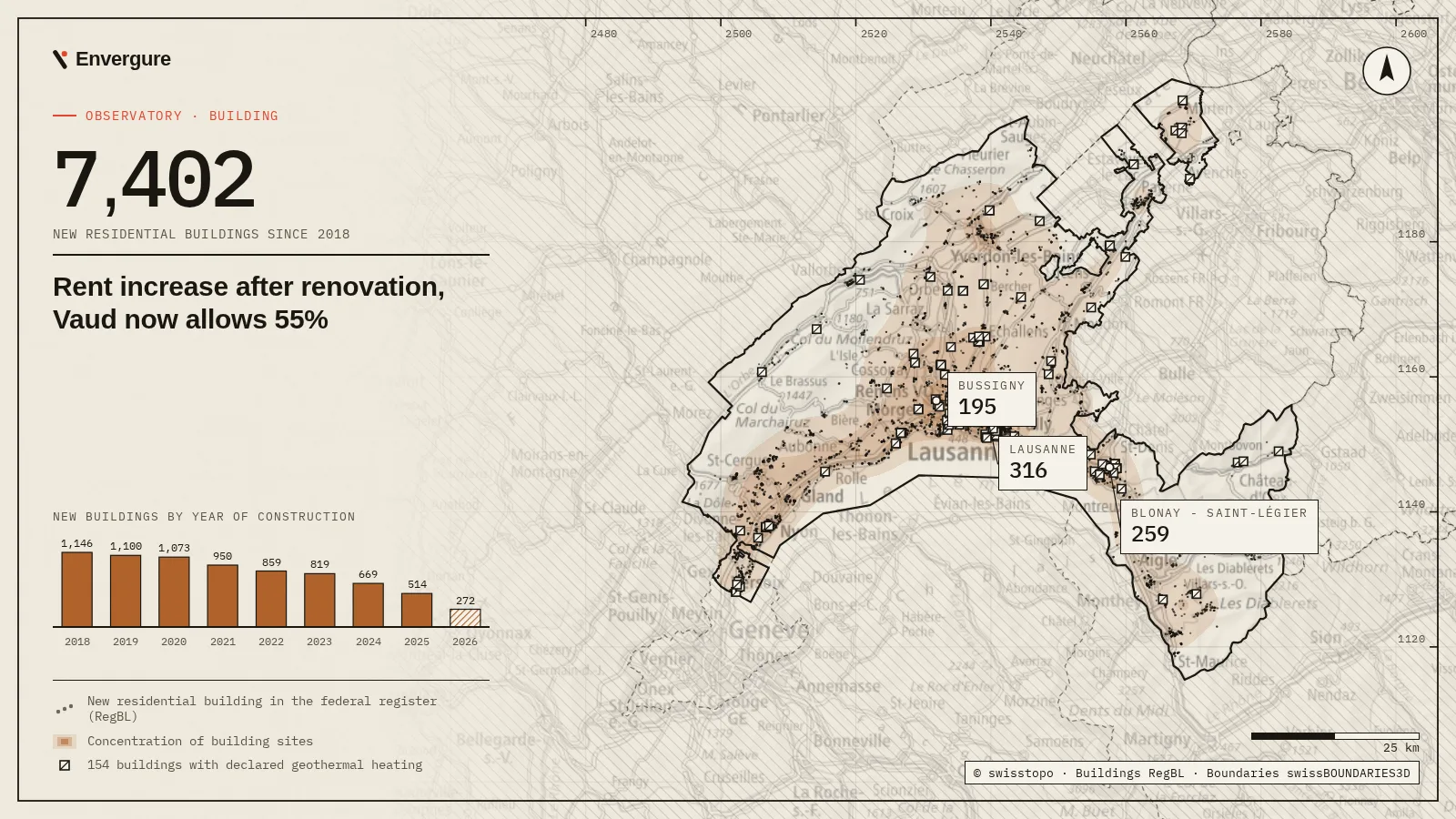
Nine, seventeen or thirty per cent was what a Vaud landlord could pass on to tenants once the builders left. Sixteen, thirty and fifty-five is the new scale, set by an administrative directive that nobody voted on.
Vaud rewrote the rent increase after renovation formula, not the law
The cantonal housing and territory department changed, through an internal directive alone, the way the admissible rental income from a renovated building is calculated. No revision of the law on preserving and promoting the rental stock (LPPPL) was required, and no vote either.
The sample cases circulated by the housing directorate show the size of the shift. Increases previously capped at 9%, 17% or 30% now reach 16%, 30% and 55% in comparable situations, according to the examples the canton published. In the third case the margin a landlord can pass on nearly doubles.
Five oral questions in one sitting, and a committee on hold
On 10 November, five members of the cantonal parliament put questions to the government during the same sitting of the Grand Conseil, Céline Misiego, Valérie Zonca, Graziella Schaller, Sébastien Pedroli and Romain Pilloud. Five separate questions on a single item is unusual.
ASLOCA Vaud and the left call it a weakening of the LPPPL decided outside parliament, while the government denies having “forced anything through”. The committee handling the substance of the file, a motion by MP Philippe Jobin and the government counter-proposal, suspended its work on 22 September in agreement with state councillor Christelle Luisier Brodard, pending a first measured review. That review will not land before 2027.
How much does a change of tenant earn in the canton of Vaud?
581 francs a month on a three-room flat, without spending anything on works. In 2024 a Vaud three-room flat occupied for less than a year rented for 1,673 francs on average, against 1,092 francs for the same type of home occupied for twenty years or more, according to the Numerus released on 17 November by the cantonal statistics office.
Over ten years the canton average net rent moved from 1,292 francs in 2015 to 1,465 francs in 2024, around 13%, close to the Swiss pace over the same period (14%). The cantonal average therefore says little about the real market, because repricing happens when a lease changes hands far more than within the occupied stock.
The rise is sharper on small flats, which turn over faster and so pass through a market adjustment more often. For a landlord, that gap remains the one public, solid figure to lean on when putting a flat back on the market, directive or no directive.
CANTON OF GENEVAGeneva votes on 29 November on 270 homes in Chêne-Bourg
Geneva voters decide on 29 November on law 13539, which rezones roughly 41,000 m² of detached-house land at Seymaz-Sud to allow residential building. The project has been frozen since a referendum backed by the Rassemblement pour une politique sociale du logement, trade unions and tenant groups gathered 5,538 signatures, declared valid on 17 December 2025.
Its supporters, the PLR and the Geneva property chamber, see at least 270 homes a short walk from the Léman Express station, while the municipal council of Chêne-Bourg issued an unfavourable opinion. The campaign pits the case for density near public transport against the risk of speculation on a well-placed plot. A yes opens buildable land worth watching, a no freezes it again for an open-ended period.
CANTON OF BERNBern caps short-term lets at 90 nights a year
The Bern administrative court published on 17 November a ruling that upholds the city of Bern’s “Lex Airbnb”. The rule limits short-term letting of second homes to 90 nights a year in total across the upper and lower old town.
The court accepts that the guarantee of property is infringed but finds the measure proportionate, leaning on a Federal Supreme Court ruling of April 2026 concerning Zurich. Active Airbnb listings in Bern went from 286 in June 2022 to 623 in June 2026. Simone Richner, who chairs the regional property owners’ section, is dropping further legal action while openly doubting the rule will change much once it applies, from early 2027 at the earliest. The Zurich precedent followed by the Bern one gives other tourist cities a base to legislate the same way.
FEDERALWhy nothing came out of Bern this week
No dated federal decision joins the picture. The two files property owners follow closely, the tightening of the lex Koller and the rent initiative, remain in administrative waiting.
Decision-making has moved to the cantons. Vaud adjusts by circular what a landlord may charge after works, Geneva puts the future of an entire district to the ballot box, and the Bern courts set what a city may impose on owners of second homes. Three different levers, none of them pulled in Bern.
What a Vaud landlord can do before 2027
- Document the state of the property before the works start. The calculation covers admissible rental income after renovation, so it rests on a starting point that has to be proven room by room.
- Promise no percentage. Until the directive is published in detail, 55% remains the top of a sample case circulated as an illustration.
- Price the simple re-let first. The 581 francs measured by StatVD come without committing a single franc to a building site.
Where the real choice is between renovating to re-let and leaving the rental market altogether, the two calculations deserve to sit side by side before the first invoice. The political calendar is at least known. The Grand Conseil will not reopen the substance of the file before the measured review, and that review arrives in 2027.