Vaud property transfer tax, up to 3.3% of the price
Up to 3.3% of the price, 240.3 million francs collected in 2025, and a motion that would take the first million out of the tax base. Where the Vaud file stands, and what Geneva, Neuchâtel and Bern already do.
By the Envergure editorial team
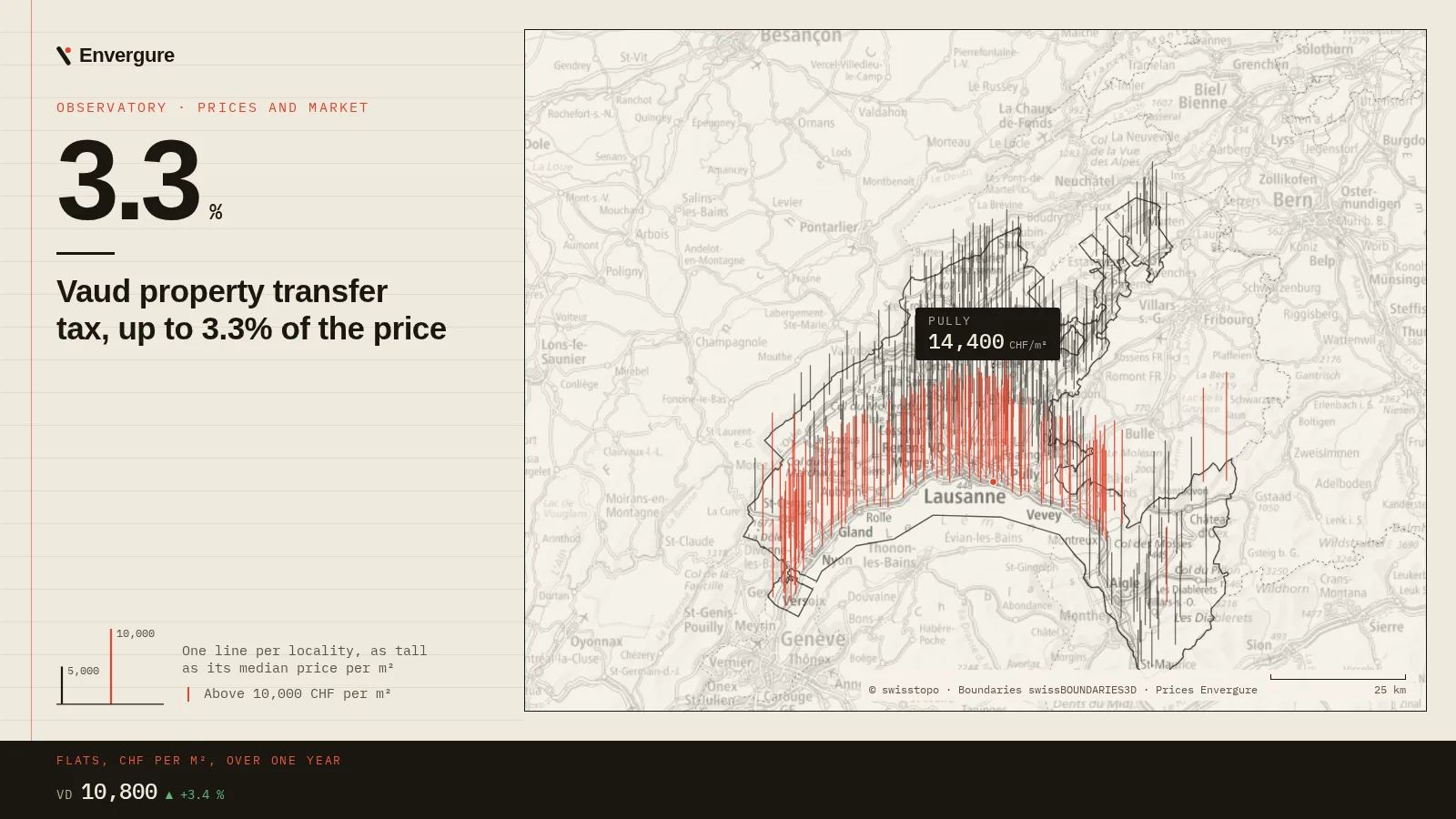
A buyer in Vaud hands over as much as 3.3% of the purchase price in property transfer tax. A motion referred to committee on 10 November 2026 would wipe that tax off the first million francs, provided the home becomes the buyer’s main residence.
CANTON OF VAUDVaud sends the first million to committee
Filed on 3 November 2026 by Quentin Racine and co-signatories from the PLR group, on behalf of Grégory Bovay, motion 26_MOT_78 asks the cantonal government to study an exemption from property transfer tax on the first million francs of a purchase price. One condition comes with it, the buyer must use the property as their main residence.
Debated in the chamber on 10 November 2026, the motion was referred to committee, with no vote on substance and no rejection. Nothing is settled, and no figure for what the measure would cost cantonal finances was put on the record during the session.
How much is property transfer tax in Vaud?
The canton takes 2.2% of the sale price. Each municipality may add up to 50 centimes for every franc the canton collects, worth another 1.1%, which pushes the full charge close to 3.3% of the purchase price. The tax brought 240.3 million francs into cantonal coffers in 2025.
On a one million franc purchase, the cantonal share works out at 22,000 francs, with up to 11,000 francs more going to the municipality. The money is due at the moment of purchase, on top of the equity the bank requires. Because the rate applies to the whole price, a purchase twice as expensive carries twice the tax, and that is the mechanism the motion goes after.
What the motion would change, and what it leaves alone
The text touches neither the cantonal rate nor the municipal share of the Vaud property transfer tax. It moves the starting point of the calculation, lifting the first million out of the taxable price when the buyer intends to live there. A flat at 800,000 francs would fall out of scope, while a house at two million would still be taxed on half its price.
On a 1.2 million franc purchase, 200,000 francs would stay in the tax base, worth about 6,600 francs at the full rate against close to 39,600 francs today. The relief caps itself, because it never exceeds the tax due on one million, or 33,000 francs. A buyer at three million would gain exactly as much as a buyer at one million.
Three neighbours have already trimmed the tax
The Vaud motion leans on cross-cantonal comparisons. Neuchâtel has cut its rate for a main residence, Geneva grants a reduction below a value ceiling set at 1,394,928 francs, and Bern is revising its own exemption rules to widen their reach.
| Canton | What applies today | Rate or ceiling | Where the file stands |
|---|---|---|---|
| Vaud | Full rate, no relief specific to a main residence | 2.2% + 1.1% | Motion 26_MOT_78 in committee since 10 November 2026 |
| Geneva | Reduction below a value ceiling | 1,394,928 francs | In force |
| Neuchâtel | Lower rate for a main residence | reduced rate | In force |
| Bern | Exemption rules being widened | under revision | Revision under way |
The two cantons are aiming at different things. Geneva caps the value of the property so the benefit stays with modest purchases, while the Vaud plan would exempt a slice of the price whatever the total. A buyer at two million would get nothing in Geneva, and would still pocket the Vaud relief.
FEDERALWhy the cost of entry is back in the argument
UBS published its real estate bubble risk index for the third quarter of 2026 on 10 November. The index eased from 0.71 to 0.64 points, and the bank still describes the risk as moderate.
The drop comes mostly from a strong economic recovery, which lowers the contribution of credit market risk. UBS now considers a price correction on owner-occupied homes unlikely in the coming quarters, and expects nominal growth of 2.5% to 3.0% in 2027.
The imbalances stay regional rather than national. Tourist areas in Grisons and the city of Zurich carry the sharpest pressure, with risks also flagged in central Switzerland and around Lake Geneva, the canton of Vaud included. For a buyer in Vaud, local demand is holding firm while the tax debate moves forward by one committee.
Should you wait until December to fix your mortgage?
Rather the opposite, going by the quarterly Resolve report on the Swiss mortgage market. The median ten-year fixed rate sits at 1.84%, up 14 basis points over the quarter, a move the report pins on capital markets rather than on lenders. It expects a dip towards 1.75% through November, then a climb back towards 2% from December 2026.
The Swiss National Bank took no decision between 1 and 15 November. Its last recorded decision, holding the policy rate at 0%, dates from 11 December 2025, and the next appointment falls in December 2026.
On the tenant side, the mortgage reference rate that rents are indexed to stays at 1.25%, unchanged since September 2025. Its next quarterly publication is due in early December.
FEDERALTwo federal files heading for condominiums
The legal affairs committee of the National Council voted 14 to 10 on 30 October 2026 to start work on modernising the law on condominium ownership. The draft would allow a condominium to be created before construction, set up a renovation fund, and frame special rights of use such as a parking space or a garden.
The article-by-article reading continues in committee, and no debate in the full chamber is expected before the winter session, which opens on 30 November 2026. In parallel, the revision of the land register ordinance, sent out for consultation on 26 August 2026, aims to standardise the supporting documents required in inheritance matters. The consultation runs until 27 November 2026, with no practical effect before that date.
In brief
- In Geneva, bill 13711 would stop the official gazette from publishing the amount of a property transaction and the names of the parties. The committee report dates from 18 August 2026, and the vote is not confirmed.
- The Federal Statistical Office published on 10 November 2026 the number of tenancy conciliation cases opened under residential and agricultural leases, 19,074 for the first half of 2026.