House worth in Switzerland, the three valuation methods
Market value, lending value, taxable value. The same property carries three figures, and each one is worked out differently.
By the Envergure editorial team
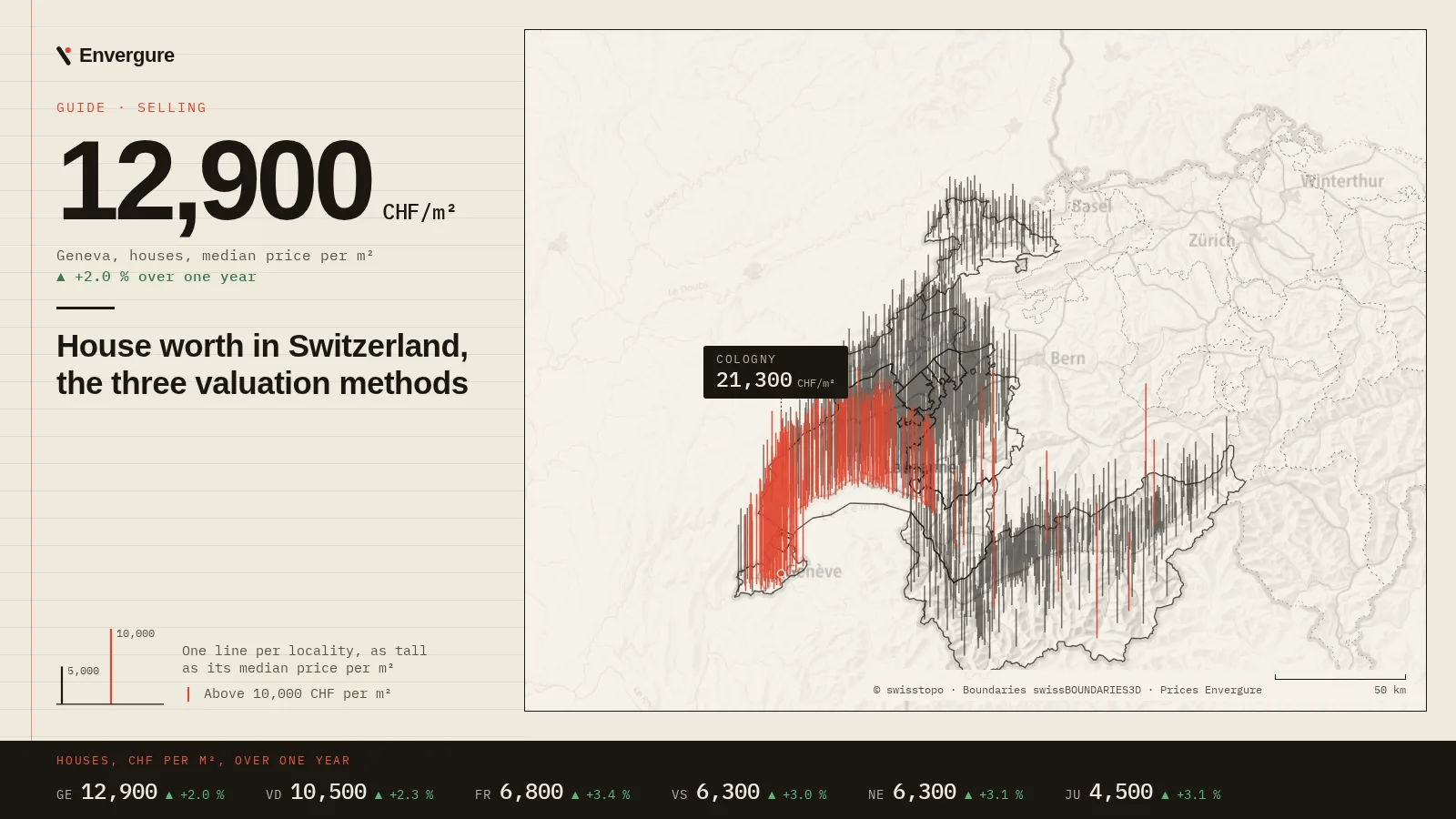
What your house is worth in Switzerland comes down to its market value, the price a buyer would probably pay on the open market. Three methods produce that figure, a comparison with recent sales, the rebuild cost less wear, and capitalised rental income. Your bank then uses the lower of two numbers, your purchase price or that market value.
Market value and sale price are two different figures
Market value is the price that can probably be obtained on the market. A valuation establishes it. The sale price comes out of the negotiation with your buyer instead, and moneyland.ch points out that the two figures do not match.
Your house therefore carries several values at once, the one you advertise, the one your buyer's bank works with, and the one a tax office asks for. They start from the same features and never land on the same number.
How much is my house worth in Switzerland, the three methods
Three methods are used in Switzerland, and each one targets a type of property.
The hedonic method compares your house with real recent sales of owner-occupied homes. It works on around seventy criteria, floor area, volume, year of construction, condition, standard and location, as UBS describes. This is the method for condominium flats and standard detached houses.
The intrinsic method estimates the rebuild cost of the building, corrects it for wear, then adds the value of the land. It takes over when comparable sales are missing, on a property outside the standard range.
The income method applies to a rental building. It capitalises the net rental income at a rate suited to the market. A small change in that capitalisation rate moves the result a long way, as the Fahrländer Partner presentation for SVIT shows.
| Method | What it calculates | Which property |
|---|---|---|
| Hedonic | Comparison with recent sales, around 70 criteria | Condominium flat, standard detached house |
| Intrinsic | Rebuild cost corrected for wear, plus the land | Listed building, luxury property, large plot |
| Income | Net rental income capitalised at a market rate | Investment building, property let out |
Methods in use in 2026, after the description of hedonic valuation published by UBS and the market presentation by Fahrländer Partner for SVIT in 2024. Our methodology sets out the data we cross-check.
What your bank counts as the value
A bank does not lend against the market value. It uses a lending value, meaning the amount it bases the mortgage on, and that amount is the lower of the purchase price and the market value of the property. FINMA recognised this lowest value principle as a minimum standard in 2014. A generous valuation therefore opens no extra credit if the buyer pays less.
Two further rules apply. The minimum standards approved by FINMA in 2012 require at least 10% of the lending value in equity that comes neither from a withdrawal nor from a pledge of the second pillar, your pension fund. The debt must then be amortised down to two thirds of the lending value, within 15 years since 1 September 2014 against 20 years before that.
Your Swiss property when you live in France
An owner living in France deals with two tax authorities. Double taxation treaties as a rule give the taxation of buildings to the state where they stand, so the property wealth stays taxable in Switzerland.
On the French side, the property wealth tax known as IFI is due as soon as net taxable property wealth passes 1.3 million euros on 1 January. If your tax domicile is in France under article 4 B of the French tax code, the base covers property in France and abroad, your Swiss house included. If your tax domicile sits elsewhere, it only covers property located in France.
Double taxation is not removed, it is corrected. The treaty of 9 September 1966 between Switzerland and France covers wealth taxes, and since the amendment of 22 July 1997 France clears double taxation with a tax credit rather than an exemption.
The value you declare is the market value on 1 January, converted into euros. One valuation therefore serves twice, to sell and to declare. Holding the property through a company changes nothing, the shares are valued according to the property share of the company's total assets.
A worked example, from purchase price to debt
Example, a chalet in Valais seen by the bank and by the French tax office
- Purchase price of the chalet
- CHF 950,000
- Market value estimated today
- CHF 1,150,000
- Possible gap of the hedonic method, 20%
- CHF 920,000 to 1,380,000
- Lending value used by the bank
- CHF 950,000
- Equity outside the second pillar, at least 10%
- CHF 95,000
- Debt to bring down to two thirds within 15 years
- about CHF 633,000
Assumptions behind the example, a couple who became French tax residents own this chalet, the market value comes from a hedonic valuation, the bank applies the lowest value principle, and the market value on 1 January converted into euros enters the IFI base if the couple's net property wealth passes 1.3 million euros.
How to get your house valued
- Gather the figures for the property Floor area, volume, year of construction, condition, work carried out and location. These are the criteria a hedonic valuation compares.
- Run a first comparative valuation It places you against recent sales of similar properties. Our property valuation starts from those same criteria.
- Have an unusual property appraised If your house falls outside the standard range, ask for an intrinsic value, the rebuild cost corrected for wear plus the land.
- Ask a bank for the lending value The bank decides your buyer's mortgage. It will keep the lower of the price paid and the market value.
- Check your tax position If you are a French tax resident, note the market value on 1 January and keep the valuation that supports it.
What to have ready before you ask for a valuation.
- Floor area and volume of the building
- Year of construction and a dated list of the work done
- Plot size and what may be built on it
- Purchase price, date, and the mortgage debt outstanding
- Annual net rental income if the property is let
- Market value on 1 January if you declare in France
Traps to check before you set a price
The second trap concerns the buyer. The federal act on the acquisition of real estate by persons abroad, known as lex Koller, makes some purchases subject to a cantonal permit. Persons abroad are EU and EFTA nationals without a legal and effective domicile in Switzerland, nationals of other states without a settlement permit, companies with their seat abroad and Swiss companies under foreign control, as the canton of Geneva sets out. The act sets no rule on price or value, it filters the buyer and not the amount. The Federal Council dropped the plan to repeal it on 13 November 2013.
Frequently asked questions
How much is my house worth in Switzerland?
It is worth its market value, the price a buyer would probably pay today, established by a valuation and not by an asking price. For a standard house or flat, a hedonic valuation compares around seventy criteria against recent sales. For anything unusual, the rebuild cost plus the land gives the firmer figure.
Which valuation method applies to my property?
The hedonic method for a condominium flat or a standard detached house. The intrinsic method for a listed building, a luxury property or a large plot, where comparable sales are missing. The income method for a building you let, where the net rent is capitalised at a market rate.
Does my bank use the purchase price or the market value?
Whichever is lower, under the lowest value principle that FINMA recognised as a minimum standard in 2014. So a valuation above your purchase price does not raise the mortgage. The bank also wants at least 10% of that lending value in equity from outside your pension fund.
How accurate is a hedonic valuation?
Close on a standard property, around 20% off on an unusual one. The model leans on real recent sales, so it loses precision where no comparable sale exists. A listed building, a luxury property or a very large plot calls for an intrinsic valuation as well.
I live in France and own a Swiss house, what do I declare?
Its market value on 1 January, converted into euros, if your net property wealth passes 1.3 million euros. A French tax resident declares property in France and abroad, so the Swiss house counts. The 1966 treaty then gives you a tax credit so the same wealth is not taxed twice. The costs of selling belong in the same calculation.
Does lex Koller lower the value of my property?
No, the act sets no rule on price or value. It filters the buyer, by making a purchase by a person domiciled abroad subject to a permit. The effect shows in the number of possible buyers, above all for a holiday home.
What has changed
- 24 October 2026 Rewritten in the full template, with the three sourced valuation methods, the lending value and amortisation rules set by FINMA, a worked example and what a French tax resident declares for a Swiss property.