Imputed rental value tax Switzerland, the 2029 end
Voters scrapped the tax on 28 September 2025 and the Federal Council set the end date at 1 January 2029. Until then every canton keeps its own method and the tax stays due.
By the Envergure editorial team
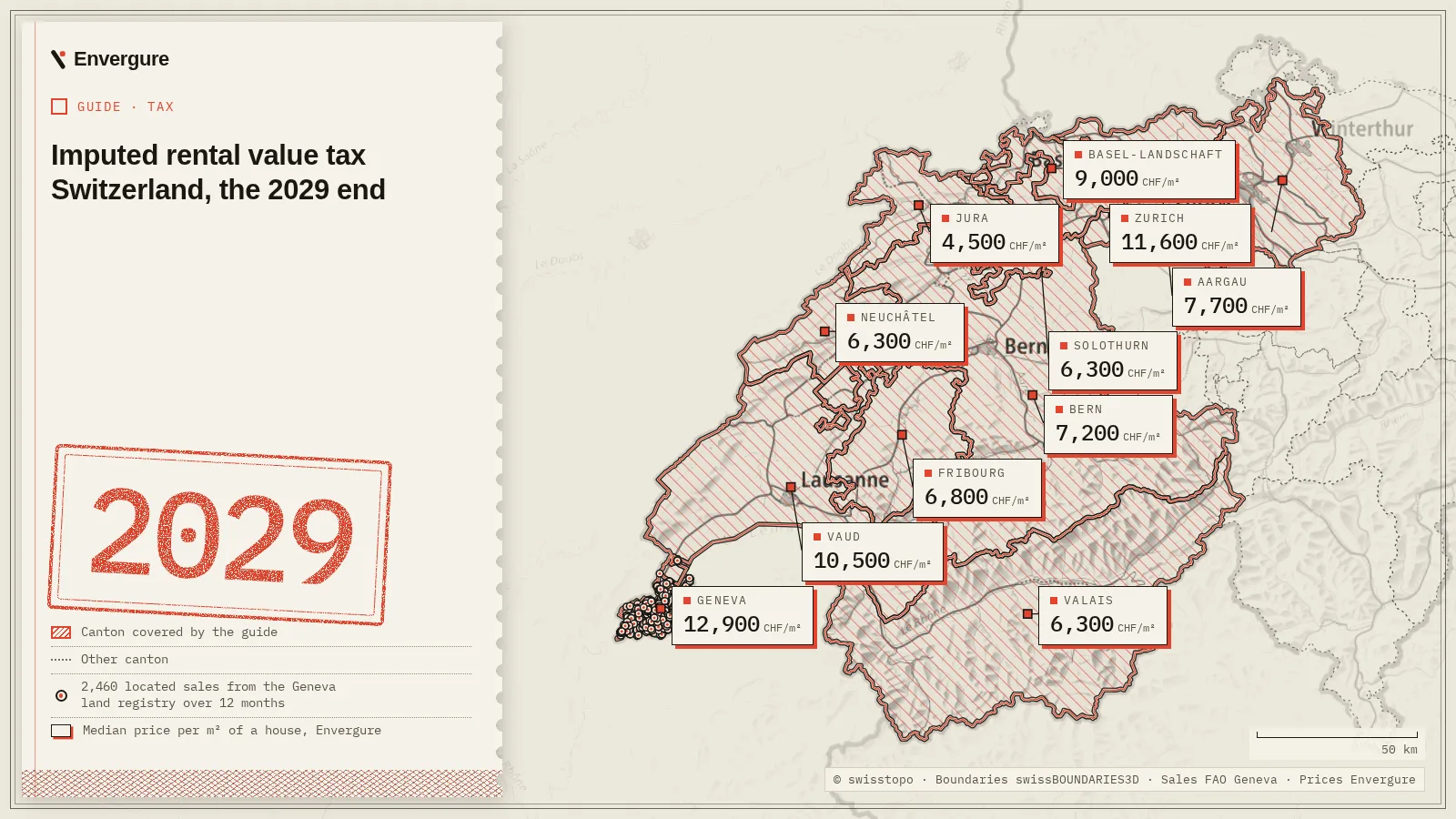
The imputed rental value tax in Switzerland adds a notional rent to your taxable income when you live in your own home. Voters abolished it on 28 September 2025 and the Federal Council set the end for 1 January 2029. Until 31 December 2028 you still pay it.
Imputed rental value tax, what it taxes
You live in your own flat or house. The tax authority treats you as paying rent to yourself, adds that notional rent to your income and taxes it. That is the imputed rental value.
The figure stays below a real market rent. For federal income tax it is set at 70% of market rental value, and the Federal Tax Administration starts from the values set by each canton, correcting them in some cantons to keep federal taxation uniform.
In exchange, current law lets you deduct your mortgage interest, your maintenance costs and your energy saving work. A heavily mortgaged owner gains from the system, an owner who has repaid the debt loses.
Imputed rental value is not the taxable value of your property. The first is income, the second is wealth, and both appear on the same tax return. Our guide on property tax and the taxable value covers the second.
When the tax ends, 1 January 2029
On 28 September 2025, the people and the cantons approved the federal decree on a cantonal property tax for second homes by 57.7% yes. That yes automatically ends the taxation of imputed rental value, for main and second homes alike, as the questions and answers from the Federal Department of Finance set out.
The Federal Council settled the date at its meeting of 1 April 2026. The reform takes effect on 1 January 2029.
Abolition as early as 2028 would have been technically possible. In the consultation, the cantonal finance directors came out by a majority for 2029 at the earliest, the time needed to adapt cantonal tax laws.
Nothing changes before then. You declare your imputed rental value for tax periods up to and including 2028 and you keep your deductions, as the Geneva tax administration points out.
What changes for your deductions after the reform
The imputed rental value leaves your taxable income. The deductions tied to your home leave with it.
- Maintenance costs on your property are no longer deductible.
- The deduction for energy saving measures disappears for federal income tax. A canton may keep it until 2050 at the latest.
- Mortgage interest stays deductible in two cases only, a property rented or leased to a third party, and a first purchase of a main home in Switzerland, through a capped and time limited deduction.
That first time buyer deduction is the only remaining help at purchase. The own funds a bank asks for do not change, see our guide on buying a home in Switzerland.
For a second home you occupy yourself, the canton will be able to levy a new special property tax, and your interest will then not be deductible. If you rent that home out in full, no such tax can be levied, your interest stays deductible and your rental income is taxed as income. Our guide on selling or renting out a property weighs the two uses.
The special tax stays optional. Each canton decides whether to introduce it and on what terms, and most have fixed nothing yet.
What the reform costs depends on mortgage rates. With future average rates around 1.5%, the Confederation and the cantons would lose some CHF 1.8 billion, of which 400 million for federal income tax and about 1.4 billion for cantonal and communal taxes. From an average rate of about 3%, the reform would raise money instead. The reference mortgage rate has been 1.25% since 1 September 2025, down from 1.5%.
The federal administration also expects a simpler system. No more imputed rental value assessments to produce, fewer supporting documents to file and fewer checks for cantonal tax offices.
Imputed rental value by canton, the methods compared
Each canton sets its own imputed rental value and the methods have little in common. Some apply a percentage of market rent, others a percentage of the cadastral assessment, others a communal points system.
| Canton | How it is calculated | Value used |
|---|---|---|
| GE Geneva | Notional rent drawn from usual rents for similar homes in the locality, capped by an effort rate | 20% of gross income at most |
| VD Vaud | Share of the indexed statistical value of the home, under the RVLoc regulation | 65% |
| FR Fribourg | Local or regional rental market, through a points system and a communal quotient | no single rate |
| VS Valais | Share of the rental market, then a flat 20% deduction once the building is over ten years old | 60% |
| NE Neuchâtel | Decreasing percentage of the cadastral assessment, by value bracket | 4.50% to 0.80% |
| JU Jura | Market rents, through an assessment based on annual income value | no single rate |
| BE Bern | Share of market rent, through a recorded rental value multiplied by a communal factor | 60% |
| AG Aargau | Share of market rent, raised on 1 January 2025 | 62% |
| BL Basel-Landschaft | Share of market rent, calculated from the corrected fire insurance value | 60% |
| SO Solothurn | Flat percentage of the cadastral assessment up to CHF 240,000, across five groups of municipalities | 10.63% to 8.80% |
Rules in force on 24 November 2026, from cantonal regulations and tax manuals for Geneva, Vaud, Valais, Neuchâtel, Aargau, Basel-Landschaft and Solothurn, and from the cantonal comparison table of the Federal Tax Administration for Fribourg, Jura and Bern, data for the 2020 tax period.
Geneva publishes no percentage. The imputed rental value there is a notional rent drawn from living area, fittings, location and the age of the home, then indexed every year. The Geneva adjustment rate stands at index 127.5 for 2026, up 1.8% on 2025. For a main home the amount cannot exceed 20% of your total gross income, and that effort rate applies only if the interest financing the property does not exceed that same amount.
Vaud starts from a statistical value, not from an observed rent. The taxable imputed rental value is 65% of that indexed statistical value, built from floor area, the age of the building, the municipality and the type of home, under the RVLoc regulation. The Vaud adjustment rate, based on the 2000 federal census of buildings and dwellings, is 30% for the 2025 tax period, against 27% in 2024. That statistical value has nothing to do with a sale price, which is worked out by three other methods.
Neuchâtel and Solothurn start from the cadastral assessment. In Neuchâtel, the gross imputed rental value is 4.50% of the assessment up to CHF 500,000, then 3.60% from CHF 500,001 to 1,000,000, 2.70% up to 1,500,000, 1.80% up to 2,000,000 and 0.80% above. In Solothurn, the rate runs from 10.63% in municipality group I to 8.80% in group V, as long as the owner occupied share stays under CHF 240,000 of assessment. Above that, the canton carries out an individual assessment based on the number of room units.
In German speaking Switzerland the gaps come down to a few points. Aargau raised its rate from 60% to 62% on 1 January 2025, then shelved on 22 September 2026 the motion asking for that increase to be suspended. Bern stays at 60%, through a recorded rental value set on the 1993 to 1996 reference period and multiplied by a communal factor, with no deduction for under use. Basel-Landschaft has been at 60% since the 2007 tax year, calculated from the fire insurance value corrected for the age of the building and the municipality. Zurich, outside the table, marks the top end with a cap of 70%.
A worked example of an imputed rental value
Example, a 4.5 room flat in Valais built in 1996
- Estimated market rent
- CHF 950 per month
- Market rent over a year
- CHF 11,400
- Gross imputed rental value, 60% of the market
- CHF 6,840
- Flat 20% deduction, building over ten years old
- -CHF 1,368
- Net taxable imputed rental value
- CHF 5,472
Assumptions behind the example, a 4.5 room flat built in 1996 in the canton of Valais, an estimated market rent of CHF 950 per month and the flat deduction chosen over actual costs. Those CHF 5,472 are added to your taxable income, before your mortgage interest is deducted. In another canton the same situation gives another figure. Official example from the Valais cantonal tax service.
Where to find your imputed rental value and how to challenge it
- Read your latest tax assessment The imputed rental value sits among your property income. It is the figure your canton uses for you, and the starting point for any check.
- Check your canton's method A percentage of market rent, a percentage of the cadastral assessment or a points system. The table above gives the rule, the cantonal regulation gives the detail of the calculation.
- Compare with real rents around you Take two or three homes of similar size, age and location. Your imputed rental value should sit between 60 and 70% of those rents, depending on the canton.
- Ask for the correction your canton allows In Geneva the effort rate caps the imputed rental value of a main home at 20% of gross income. In Basel-Landschaft, an imputed rental value above 60% of market rent can be brought back to that floor, on a written and reasoned request.
- Choose between actual costs and the flat rate In Valais the flat rate is 20% of the gross imputed rental value once the building is over ten years old. In Neuchâtel it is 10% of gross income up to ten years, capped at CHF 7,200, and 20% beyond, capped at CHF 12,000. Add up your invoices before you decide.
- File an objection if the figure stays wrong The route is an objection to your cantonal tax administration, within the deadline printed on the assessment.
- Schedule major work before the end of 2028 Maintenance costs stay deductible for tax periods up to 2028. Once the reform takes effect, they no longer are.
What to gather before you check a figure.
- Your latest tax assessment
- The living area and year of construction of the home
- Two or three rents for similar homes in your locality
- Your maintenance invoices for the year
- The annual interest statement from your bank
Frequently asked questions
When does the imputed rental value tax end?
On 1 January 2029. The Federal Council set that date on 1 April 2026, after the popular yes of 28 September 2025. Tax periods up to and including 2028 stay under current law.
What is imputed rental value in Switzerland?
A notional rent added to your income. When you live in your own home, the tax authority taxes the rent you would have collected by letting it out, reduced to reflect the fact that you collect nothing. In exchange you deduct your mortgage interest and your maintenance costs.
What percentage of market rent is taxed?
70% of market rental value for federal income tax, and at least 60% at cantonal level under Federal Supreme Court case law. Bern, Valais and Basel-Landschaft use 60%, Aargau 62%, Zurich up to 70%. Vaud, Neuchâtel and Solothurn calculate on a base other than market rent.
Does the imputed rental value drop after ten years?
No, not the imputed rental value itself. What changes is the flat deduction for maintenance costs. In Valais it is worth 20% of the gross imputed rental value once the building is over ten years old. In Neuchâtel it rises from 10% to 20%, with the cap moving from CHF 7,200 to CHF 12,000.
Does imputed rental value apply to a second home?
Yes today, and it will go in 2029 as well. In its place, cantons and municipalities will be able to levy a special property tax on second homes used mainly by their owner. That tax is optional and each canton sets its own terms.
What happens to deductions once the tax is gone?
Most of them go with it. Maintenance costs stop being deductible, the energy saving deduction ends for federal income tax and may be kept by a canton until 2050 at the latest, and mortgage interest stays deductible only for rented property and for first time buyers of a main home, under a capped and temporary deduction.
Where do you find your imputed rental value?
On your tax assessment, under property income, or from your cantonal tax administration. Geneva also publishes its annual adjustment rate, at index 127.5 for 2026, which explains an increase even when nothing in your home has changed.