Can foreigners buy property in Switzerland, the rules
Which passport and which permit let you buy without approval, and how many holiday homes each canton releases every year.
By the Envergure editorial team
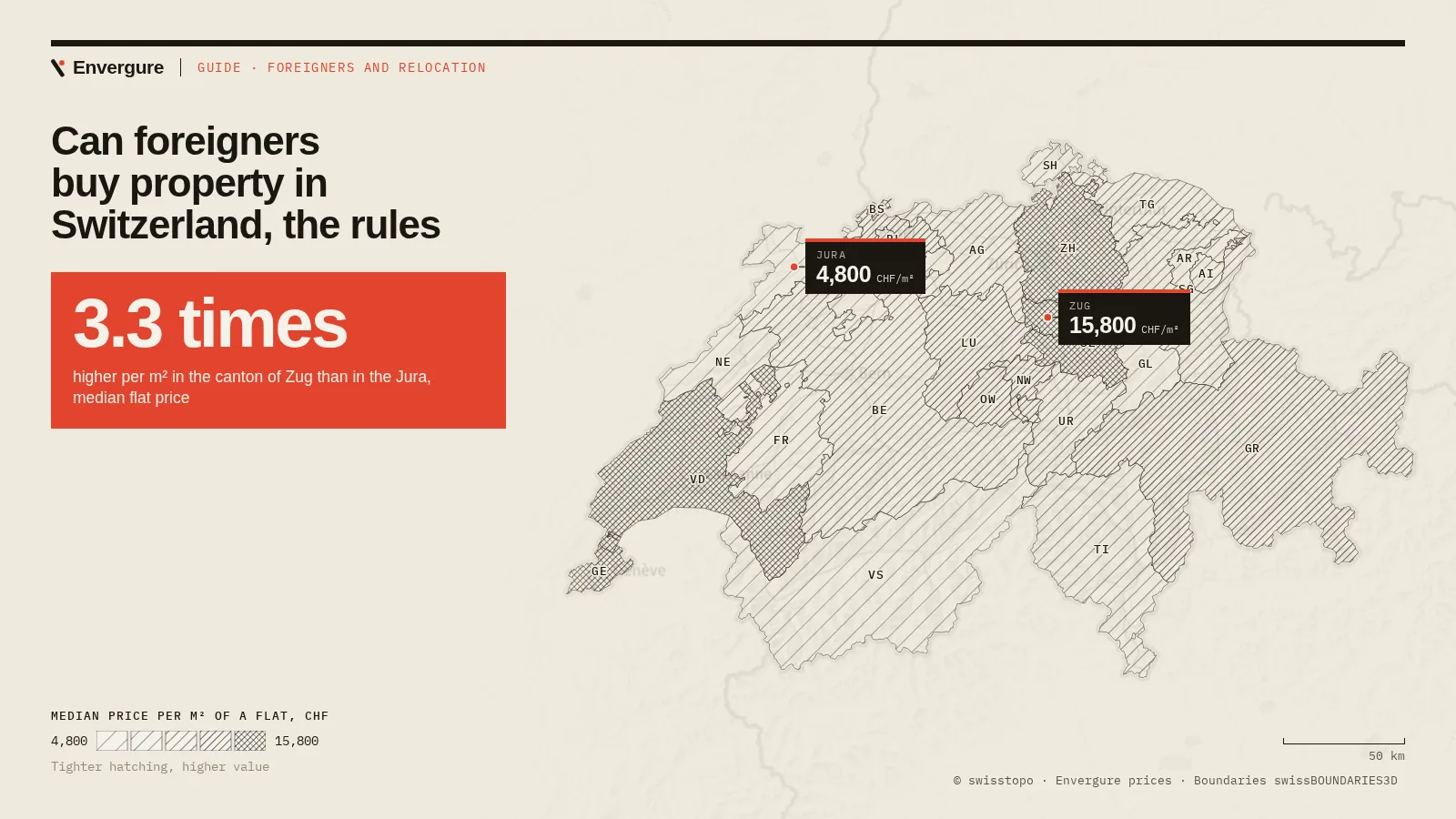
Foreigners buy property in Switzerland under the Lex Koller. A C settlement permit, or an EU or EFTA passport plus a real Swiss address, means no approval at all. A B permit holder from outside the EU may buy the home they live in themselves. Holiday homes need cantonal approval and sit inside an annual quota.
What the Lex Koller law says
Lex Koller is the nickname of the Federal Act on the Acquisition of Real Estate by Persons Abroad, known as LFAIE (RS 211.412.41). It makes any purchase of property by a person abroad subject to approval by the authority of the canton where the property sits, as the Federal Office of Justice sets out. The name comes from former Federal Councillor Arnold Koller, and the act has carried it since 1983 according to the canton of Zurich.
The act does not target every foreigner. A person abroad is a national of a third country without a legal and effective Swiss address, a company with its registered office abroad, or a company based in Switzerland but under the dominant control of persons abroad, as the canton of Geneva explains. A third country is any country outside the European Union and EFTA.
Holders of a C settlement permit fall outside the act entirely. Whether they come from the European Union or anywhere else, they are treated as Swiss nationals and face no restriction. Commercial property also escapes approval when it serves exclusively as a permanent business establishment for a company, a trade or a profession, even if the buyer has no Swiss address or registered office.
When your case is not clearly outside the act, the cantonal authority decides file by file. It may grant approval only on a ground written into the LFAIE or into the cantonal implementing law.
Can foreigners buy property in Switzerland with a B permit
Yes, for the home you live in yourself. A national of a third country, B permit included, acquires a main residence at their legal and effective address without approval, the canton of Zurich states. The property has to be where you actually live, not an investment and not a second address.
A legal and effective address means the place where you genuinely live, with the intention of staying. Your residence permit alone does not prove it. The authority looks for hard signals, shared family life on site, your car registered in Switzerland, unlimited tax liability, or regular membership of a local club.
That door closes when you leave. The implementing ordinance requires you to resell the property within two years once it no longer serves as a main or secondary residence (article 11 paragraph 2 letter e OAIE).
Buying property in Switzerland as an EU citizen
A national of the European Union or EFTA with a legally established and effective address in Switzerland is not a person abroad and escapes the approval regime, reading article 5 paragraph 1 letter a LFAIE the other way round. The Federal Supreme Court settled this in ATF 136 II 405. A French citizen living in Nyon therefore buys a flat like a Swiss resident, with no application and no quota.
A French citizen who stays in France sits in the other case. Without a Swiss address, they remain a person abroad even with a European passport. Their workable route is a holiday home or an apart-hotel unit, subject to approval, and only in a canton that holds a quota.
The rest of the buying route is covered in our guide on the steps and own funds of a Swiss purchase.
Which cantons can foreigners buy holiday homes in
Annex 1 of the implementing ordinance (OAIE, article 9) sets a national ceiling of 1500 approvals per year for purchases of holiday homes and apart-hotel units by persons abroad. An apart-hotel unit is a flat inside a working hotel that you occupy only part of the year. That total is shared between the tourist cantons listed in the annex alone, 17 out of 26, per the text of the OAIE.
A canton missing from the annex holds no quota, so it has no approval of this kind to issue. Geneva, Zurich and Zug are in that position, three markets where a buyer without a Swiss address has no second home to hope for by this route.
| Canton | Annual quota |
|---|---|
| GE Geneva | 0 |
| VD Vaud | 175 |
| FR Fribourg | 50 |
| VS Valais | 330 |
| NE Neuchâtel | 35 |
| JU Jura | 20 |
| ZH Zurich | 0 |
| TI Ticino | 195 |
| ZG Zug | 0 |
Annual approval quotas for a holiday home or an apart-hotel unit, annex 1 of the OAIE, as at 2026. Sources, the text of the OAIE, and the canton of Zurich for Zurich. Geneva, Zurich and Zug do not appear in annex 1 and therefore hold no quota.
Valais alone holds 330 approvals, 22 per cent of the national ceiling, ahead of Ticino and Vaud. Our price markers for canton Valais and our tracking of property prices in Ticino show the entry level in both markets.
The nine cantons compared here hold 805 of the 1500 annual approvals between them, a little over half the federal ceiling. The remaining 695 are split between the eleven other cantons listed in annex 1.
In Valais the quota is not the only door. Inside tourist zones, buying a holiday home also requires a certificate from the Spatial Development Service under the cantonal second homes act, separate from the Lex Koller approval, the canton of Valais specifies.
Example, a flat in Lausanne and a chalet in Valais
Example, a French couple holding a B permit
- Flat in Lausanne, lived in by the couple
- 0 approvals
- Holiday chalet in a Valais tourist zone
- 1 approval
- Valais quota for the year
- 330 approvals
- Quota left after this file
- 329 approvals
- Total Lex Koller approvals
- 1
Assumptions, two French nationals holding a B permit, resident in Lausanne where they live in the flat they bought, also buying a chalet in a Valais tourist zone. The chalet uses one of the 330 Valais approvals for the year and additionally needs the Valais second homes certificate, which is not a Lex Koller approval. The same chalet in Geneva, Zurich or Zug would fail for lack of a quota. If they move back to France and stop living in the Lausanne flat, they must resell it within two years.
How to apply for cantonal approval
- Establish your status Set out your nationality, your residence permit and your real address. A C permit puts you outside the act. So does an EU or EFTA passport combined with an effective Swiss address.
- Classify the property A main residence you live in, a holiday home, an apart-hotel unit or a building used as a permanent business establishment each follow their own regime. A valuation of the property gives you its market value before you commit.
- Write to the cantonal authority It decides alone, file by file. In Geneva the Department of Institutions and Digital Affairs issues either the purchase approval or a ruling of non-liability, which anyone whose liability is not clearly excluded has to request. In Valais the legal office of the land registry service is the first instance authority. In Zurich it is the district council, the Bezirksrat of the district where the property sits.
- Add the cantonal certificate in a tourist zone In Valais a holiday home inside a tourist zone requires a certificate from the Spatial Development Service under the second homes act, on top of the Lex Koller approval.
- Appeal a refusal if you need to In Zurich the district council decision goes to the Baurekursgericht, the building appeals court, with the whole process supervised by the Office for Economy and Labour and the Federal Office of Justice.
What demonstrates a legal and effective Swiss address, according to the canton of Zurich.
- Your residence permit, which never suffices on its own
- Shared family life in the same place in Switzerland
- Your car registered in Switzerland
- Your unlimited tax liability in Switzerland
- Your regular participation in a local club
Traps in the Lex Koller
Is the Lex Koller being tightened
A tightening is in preparation, not in force. The Federal Council instructed the Federal Department of Justice and Police to prepare a revision of the LFAIE on 29 January 2025, then adopted a draft on 15 April 2026. Consultation ran from 15 April to 15 July 2026, and the positions of cantons, communes, parties and private individuals were published on 27 July 2026.
Four changes sit in that Federal Council draft. Buying a main residence would become subject to approval for nationals of a state that belongs to neither the European Union nor EFTA, with resale within two years on leaving Switzerland. The commercial property exemption would be reserved for a buyer who runs the establishment themselves, closing off purchases made to let or lease out. Cantonal holiday home and apart-hotel quotas would be cut, with no figures in the official release, and sales between persons abroad would again need approval. Buying listed shares in residential property companies and exchange traded property funds would be removed.
The revision belongs to the measures accompanying the popular initiative against a Switzerland of 10 million people, which the Federal Council recommends rejecting. As at 3 November 2026, the tracking page of the Federal Office of Justice announces no date of entry into force. The rules described above are therefore the ones that apply today.
Frequently asked questions
What is the Lex Koller law
It is the nickname of the Federal Act on the Acquisition of Real Estate by Persons Abroad (LFAIE, RS 211.412.41). It makes the purchase of property by a person abroad subject to approval by the canton where the property sits. It is named after former Federal Councillor Arnold Koller and has applied under that name since 1983.
Can foreigners own property in Switzerland
Yes, in at least three situations. With a C settlement permit, with no restriction at all. With an EU or EFTA passport plus a legal and effective Swiss address, again without approval. With a third country B permit, for the home you live in yourself at your own address.
Where can foreigners buy property in Switzerland
Any canton, when the purchase is a main residence you live in or a commercial building used as a permanent establishment, because neither needs a quota. For a holiday home, only the 17 cantons listed in annex 1 of the OAIE, with Valais at 330 approvals a year, Ticino at 195 and Vaud at 175.
Can foreigners buy property in Lugano, Switzerland
Yes, within the Ticino quota of 195 approvals a year for holiday homes and apart-hotel units, if you have no Swiss address. If you live in Ticino and hold an EU or EFTA passport, or a C permit, no approval is needed at all.
Can foreigners buy commercial property in Switzerland
Yes, without approval, when the building serves exclusively as a permanent establishment for a company, a trade or a profession. The buyer needs no Swiss address or registered office. The 2026 draft revision would reserve that exemption for a buyer who runs the establishment themselves.
Can foreigners buy property in Switzerland without a visa
Owning property and having the right to stay are two separate questions. The Federal Office of Justice states that owning Swiss property creates no right to a residence permit, and residence is decided by the State Secretariat for Migration or the competent cantonal office. Without a Swiss address you are a person abroad, so only a holiday home inside a cantonal quota is open to you.