Ticino property prices, the one canton losing ground
Owner-occupied flats are up 5.9% year on year in Switzerland. Ticino is the only canton where professionals expect a drop, and Lugano the one business hub where they expect it outright.
By the Envergure editorial team
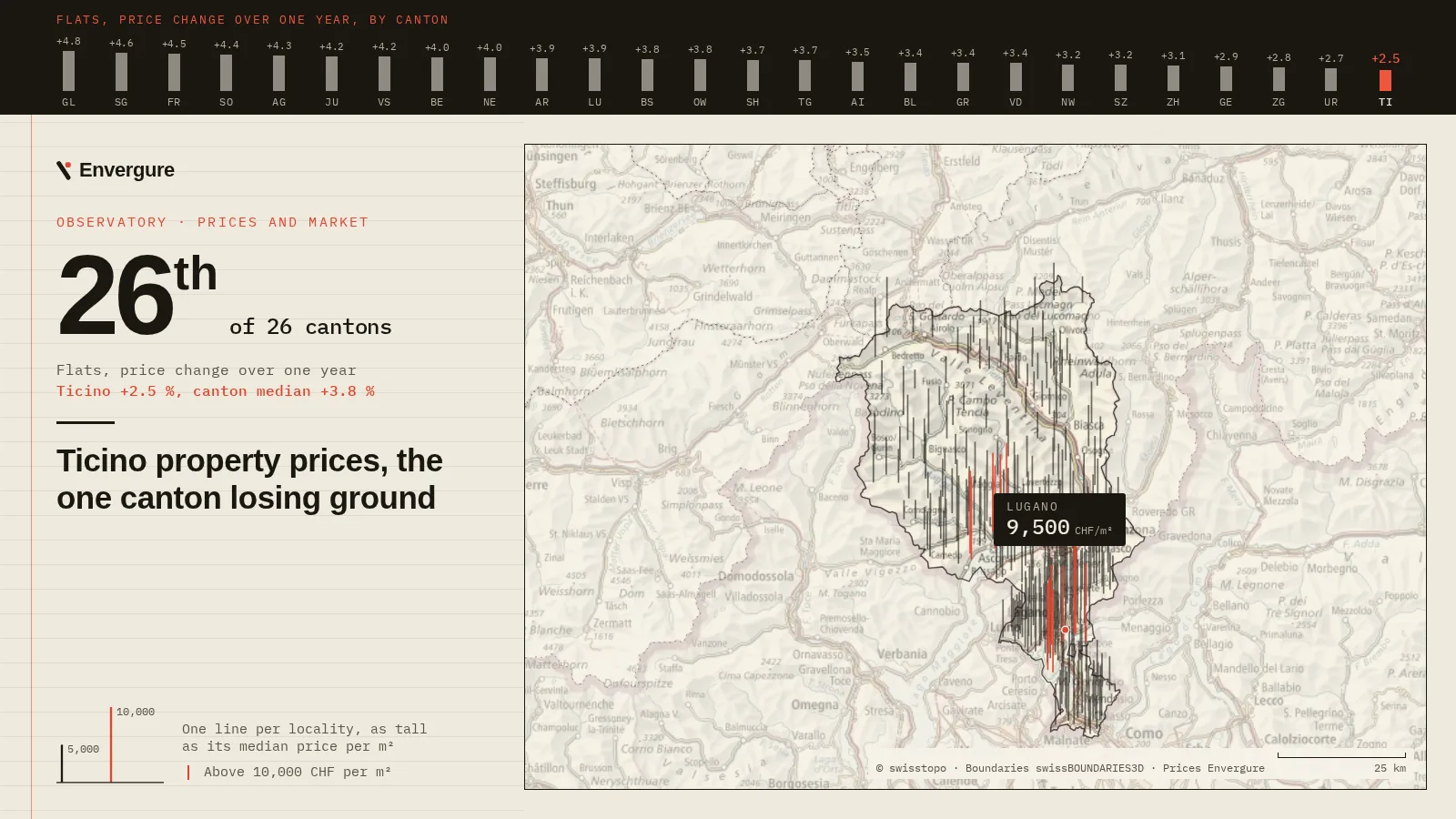
Owner-occupied flats gained 5.9% across Switzerland over the past year. Yet Ticino is the only canton where professionals expect a fall, and Lugano the one Swiss business hub where they are betting on it outright.
Transaction prices are speeding up, with flats in front
On 12 October, Raiffeisen released its third-quarter transaction price index. Detached houses added 2.0% over the quarter and 3.6% over the year. Owner-occupied flats did better, 1.7% over the quarter and 5.9% over twelve months.
A quarter earlier, the same flat segment was running at 4.2% year on year. Gaining 1.7 points in three months is a wide step for an index that normally moves in small increments.
Why are flats rising faster than houses?
Because housing supply is not keeping up, and the recent rise in fixed mortgage rates is too small to cool demand. That is the reading of Fredy Hasenmaile, chief economist at Raiffeisen Switzerland, who expects no slowdown while housing stays this scarce.
The split by type of commune says more than the national average. Over one year, owner-occupied flats gained 7.9% in tourist communes and 1.6% in urban centres, a one to five ratio inside a single index.
Houses did not follow that pattern, with 3.6% over the year on the Raiffeisen index against 5.9% for flats. The pressure sits on the segment that resort buyers and city first-time buyers compete for.
So an owner holding a flat in a ski resort and an owner holding a flat downtown read the same national index without living in the same market. The average is accurate, and it sets nobody’s asking price.
CANTON OF TICINOTicino, the only canton where professionals expect a fall
The sharpest signal comes from expectations rather than prices. KPMG’s SRESI index, published on 29 September, surveys 370 industry specialists about the year ahead. It fell back to 47.5 points nationally, against 69.5 a year earlier, the highest reading since the survey began in 2012.
Beat Seger of KPMG calls it a return to normal after an exceptional year rather than a reversal, with the strongest increases still expected in Zurich, central Switzerland and around Lake Geneva. Ticino is the country’s only negative exception. Lugano is the one Swiss business hub where investors expect prices to fall outright, and the canton as a whole also sits in negative territory.
Should you rethink your asking price in Ticino?
Yes, if that price was set from national headlines. A Ticino seller who anchors expectations to the 5.9% posted by Swiss owner-occupied flats is off by several percentage points, and off by one market.
Two pieces of information sit on top of each other and say different things. Swiss prices are still rising. The professionals surveyed expect Ticino’s to fall within a year. The first can be checked against deals already signed, the second weighs on what a buyer will dare to offer this winter.
Our reading, in Ticino the asking price is set from comparable sales in the commune, and the selling period is budgeted longer than elsewhere. That caution has a cost. A price cut on the strength of a fall that is only expected so far leaves money on the table when the buyer shows up quickly.
FEDERALMortgage credit does not explain the gap
The Swiss National Bank has not revisited the question since its decision of 24 September, which kept the policy rate at 0%. The next meeting is expected in December.
On fixed rates, a Moneypark study carried by the ATS news agency puts the average 10-year rate at 2.06% in mid-September, against 1.98% three months earlier. International comparison puts that increase in proportion.
What is left is what the KPMG survey points to without quantifying it, weaker local demand and expectations that have turned. That is the ground on which Ticino stands apart this autumn, not the cost of credit.
VAUD AND GENEVAIn brief
Vaud, communes keep their share of the property gains tax
The Vaud cantonal government wanted to change how the property gains tax is split between canton and communes, today 58% for the canton and 42% for the communes. The cantonal parliament rejected that change in the 2026 budget vote, which would have cost communal finances around 39 million francs a year. A Vaud seller will see no difference on the bill, only the split was at stake.
Another Vaud figure, vacant commercial and industrial floor space jumped to 374,007 m² in 2026, against 285,288 m² a year earlier, a rise of more than 31%. Statistique Vaud also announces that the final vacant housing figures by number of rooms are due this autumn.
Geneva, 80 million for renovation and one grant withdrawn
The canton is making 80 million francs of energy subsidies available for 2026, 10 million more than in 2025. The new scale drops the grant for energy project management support, which until now helped owners put their application together. Anyone planning work this year reworks the financing plan accordingly.
On planning, the Mervelet neighbourhood project in Petit-Saconnex is approaching its public consultation, due this autumn for 30 days, after two public meetings held at Villa Dutoit on 7 and 8 October. On the market side, Geneva transaction volume reached about 2.002 billion francs in the second quarter on 668 sales, against 766 a year earlier, the gap coming down to a handful of large deals on residential and office buildings.