Terminating a Swiss lease early, the Zurich warning
Three stairwells up to twelve weeks late, and about 300 Zurich tenants who had already given notice. What the delay says about timing risk.
By the Envergure editorial team
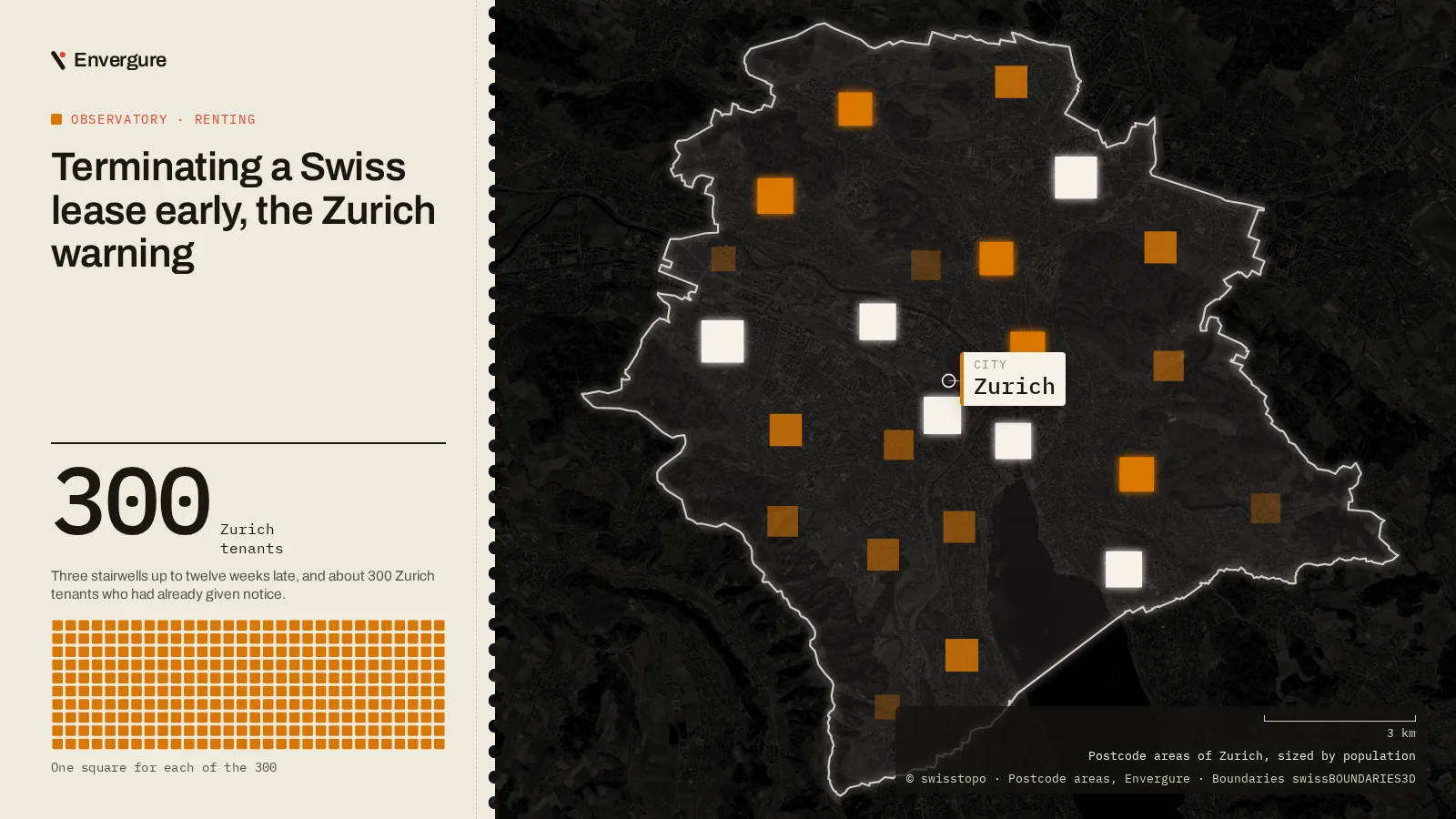
About 300 tenants in Zurich had given notice on their flats so they could move into a new housing cooperative. The stairwells are up to twelve weeks behind, and the old leases run out anyway.
CANTON OF ZURICHThree stairwells behind schedule, 300 leases already ended
The Koch-Areal cooperative project in Zurich-Altstetten was meant to hand over 123 flats for 450 people, with move-ins staggered from late October 2026 to late February 2027. The stairwells are not finished, two of them running up to six weeks late and a third ten to twelve weeks (Blick, 20 October 2026).
The Kraftwerk1 cooperative, through its spokeswoman Anna-Katharina Ris, has drawn on the network of other cooperatives and turned up 60 temporarily empty flats. Compensation for the extra costs is described as likely, with the terms still to be settled.
What happens to a tenant who has already given notice?
They end up with a gap, and they carry it alone. Notice takes effect on the date agreed with the old landlord whether or not the building across town is ready, and the delay is a matter between the tenant and the developer.
Terminating a Swiss lease early is in practice a bet on a construction schedule, a document that has never bound anyone. At Koch-Areal there is at least a safety net. Sixty flats for roughly 300 affected households covers one case in five. The rest go looking on the ordinary rental market, the one whose tightness was the reason for building in the first place.
Where do you go when the move-in date slips?
In the tightest markets, nowhere. The Federal Housing Office treats a market as no longer functioning normally below 1.5 per cent of flats standing empty, and several cantons are now well under that line.
Lucerne stood at 0.70 per cent on 1 June 2026, or 1503 empty flats, and the share of the stock actually offered on the market fell from around 8 per cent in 2022 to around 4 per cent in 2025 according to the cantonal bank (LUKB). The city of Lucerne was at 1.01 per cent in 2025 (City of Lucerne). In Thurgau the cantonal rate slid from 1.70 per cent in mid-2022 to 1.41 per cent in mid-2025, with the Kreuzlingen district lowest of all (Thurgau parliament).
The city of Fribourg was at 0.91 per cent in the third quarter of 2025, against cantonal rents up 24 per cent over twenty years (city council motion). Jura remains the French-speaking exception, at 2.98 per cent on 1 June 2024 and 5.8 per cent in Delémont (immobilier.ch). All these readings predate last week, so they are background rather than news.
Two federal files open, no milestone this week
Between 11 and 25 October 2026 there was no final vote, no Federal Supreme Court ruling and no new rate. Every live file carries a last milestone dated end of September or earlier.
The first concerns the ordinance on residential leases (OBLF), whose revision would write the Federal Supreme Court case law on permissible rental yield after renovation into the text itself. The consultation ran from February to June 2026 and nothing has been decided since (position of the canton of Geneva, 3 June 2026).
The second is an indicator. The UBS Swiss real estate bubble index moved from 0.69 to 0.72 points in the second quarter of 2026, still inside the moderate risk band, where a sharp price correction is judged unlikely in the short term (UBS, via Bilanz).
CANTON OF GENEVAGeneva votes on brokerage rules on 29 October
The Geneva parliament takes up the committee report on bill 13732, which would regulate property brokerage in the canton (LCImm), on 29 October 2026. Filed in December 2025 by a group of members led by Caroline Renold, the text sets a minimum quality standard for brokers, protection for clients against abuse of a dominant position and conflicts of interest, and a limit on bidding up rents and prices (PL 13732-A, order of business).
The committee produced one majority report and two minority reports, which says more about the gap between positions than any commentary would. The vote falls after this edition goes out, and the outcome is open.
Geneva rents are climbing more slowly
The latest available OCSTAT bulletin, from June 2026, puts the rise in free-market rents for older flats at 1.3 per cent between May 2025 and May 2026, against 1.8 per cent the year before. Chene-Bougeries leads at 2.8 per cent, while Meyrin and the outer suburban communes trail at 0.9 per cent (bulletin no. 06-2026).
Behind all this, the Praille-Acacias-Vernets district keeps rebuilding itself, 230 hectares and some 12,000 flats targeted by 2050, of which 1355 on the Quai Vernets site with two thirds in public-utility housing, plus the announced relocation of part of the 500 businesses inside the perimeter (immobilier.ch).
CANTON OF VAUDVaud still has no referee for post-renovation rents
On 6 October 2026 member of parliament Mathilde Marendaz filed an oral question accusing the cantonal government of trying to push tenants’ bills up after renovation by changing how the objective rental income is calculated, a figure that folds in wear and tear and the history of mortgage rates (vd.ch). No answer has been published.
The revision of the law on preserving and promoting the rental stock (LPPPL), which has to arbitrate between a floor return for owners after works and protection for tenants in shortage areas, is stuck. The list of pending items closed on 8 October records that the committee has suspended its work pending further information from the cantonal government, the same wording as at the end of August despite a session held on 22 September (list as at 08.10.2026).
The pre-emption right half of the revision is no further along, its committee not due before 27 November 2026. A Vaud tenant whose building is being renovated therefore lives under the old rules for two more months at least.
| File | Level | Next known milestone |
|---|---|---|
| Property brokerage, PL 13732 | Geneva | 29.10.2026 |
| LPPPL, pre-emption right | Vaud | 27.11.2026 |
| Revaluation of tax values | Zurich | 01.2027 |
| Revision of the OBLF | Federal | no date |
In brief
- Maienfeld (GR). A patrician manor house built around 1700 is looking for a buyer, eighteen rooms over three floors, some 600 m² of living space, 1516 m² of land, a stable and a walled garden with a pavilion. The house is a listed monument, with rococo stucco and load-bearing walls that cannot be touched, though the broker says a modern kitchen stays possible. The facade still carries the coat of arms of the family of Hortensia Gugelberg von Moos, described as the only German-speaking Swiss woman to have published in the 17th century (Blick, 17 October 2026).
- Kesswil (TG). The Confederation is putting a former customs post up for public auction, 507 m² of land on the shore of Lake Constance with its historic boat ramp. Canton and commune both hold a pre-emption right at the highest price bid, and the commune looks more interested in the lakeside land than in the building, long rented out to the customs staff welfare fund. Residents fear a stretch of public shoreline passing into private hands (Blick, 21 October 2026).
- Zurich (ZH). Back in autumn 2025 the canton dropped the increase in imputed rental value planned for 2026 and keeps applying its 2009 directive while it waits for the federal abolition. A general revaluation of property tax values is announced, with notices going out to owners in January 2027 (canton of Zurich). The notices go out in January 2027, which makes that month the time to check the figure rather than file the letter away.
Which leaves the Maienfeld price, which the broker David Hauptmann releases only on request, and sums up like this.
More affordable than you would imagine, but dearer than an ordinary family house.David Hauptmann, handling the sale, quoted by Blick