Lake Geneva prices, houses surge as flats stall
Houses jumped 6.3% on Lake Geneva over the year while owner apartments slipped 1.4%. Plus Lex Koller, mortgage debt past 1,300 billion, and record-low vacancy.
By the Envergure editorial team
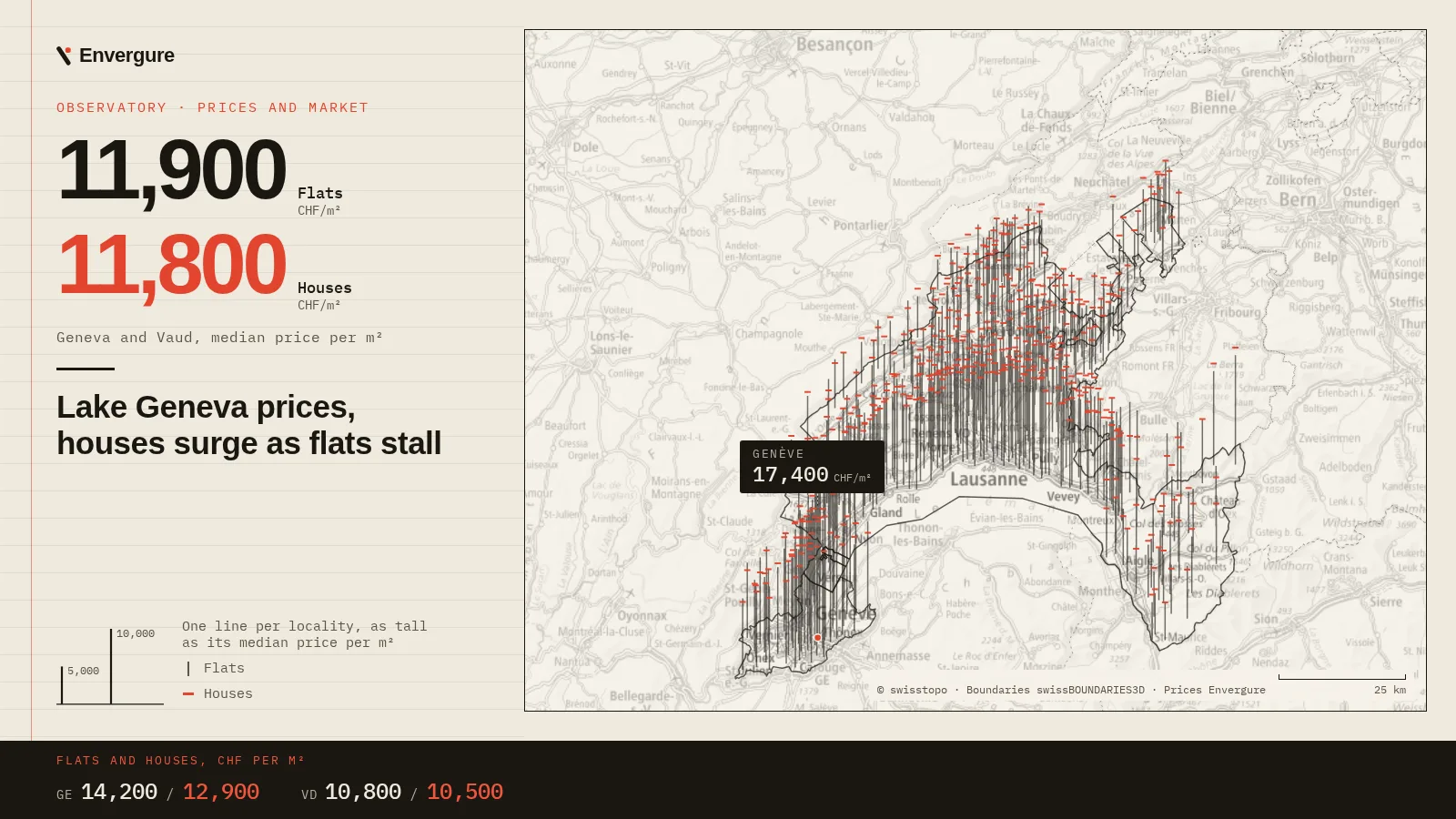
On the Lake Geneva arc, single-family houses are surging while owner-occupied apartments have stalled. At the same time, Bern is tightening access for foreign buyers and the country's mortgage debt has crossed 1,300 billion francs.
LAKE GENEVA ARCThe widening gap between houses and apartments
The second-quarter 2026 figures show two markets pulling apart. Over the year from Q2 2025 to Q2 2026, single-family house prices jumped 6.3% across the Lake Geneva arc, driven by demand for standalone homes that shows no sign of easing. Over the same period, owner-occupied apartments fell 1.4% in the Lake Geneva region, according to figures reported by RTS. The reversal is striking, since condominiums had been leading the market higher in recent years.
Nationally, the picture is smoother. The Federal Housing Office's residential property price index rose 4.8% for owner-occupied apartments and 4.6% for houses in Q1 2026 year on year (Federal Housing Office). The house-versus-apartment gap on Lake Geneva is far wider than the national average.
For a seller, the property type now sets the balance of power at the negotiating table. A well-located house sells from a position of strength. An owner-occupied apartment calls for more patience, or a price set right from the listing.
FEDERALThree files playing out in Bern
Lex Koller, tighter rules for foreign buyers
The Federal Council put a revision of the Lex Koller out for consultation from 15 April to 15 July 2026, targeting entry into force in 2027 (RTS). The draft brings three substantive changes.
- A foreigner who bought a primary residence in Switzerland would have to sell it within two years of leaving the country.
- Non-residents would lose access to shares in listed residential real estate companies and to regularly traded property funds.
- The authorisation regime is tightened for buyers from outside the European Union and EFTA.
Detailed breakdowns come from PwC Switzerland and MLL News. For a seller whose likely buyer is foreign, or a foreign owner weighing a sale, this directly affects the pool of solvent buyers at the top of the market, especially in Geneva and along the Lake Geneva arc where international clients carry more weight than elsewhere.
One thousand three hundred billion in mortgage debt
Total outstanding mortgage loans in Switzerland passed 1,300 billion francs at the end of 2025, up 3.1% or 39 billion over the year, according to an industry study reported by Le Temps. At the same time, lenders' margins are narrowing, a sign of sharper competition between banks and insurers on credit. In the short run, a borrower who negotiates financing can gain. It is still worth watching, because if the margin squeeze comes with higher refinancing costs, the pressure will eventually pass through to the rates offered to clients.
Vacancies at their lowest, Geneva in front
On 1 June 2025, Switzerland counted 48,455 vacant homes, a rate of 1.00%, down for the fifth year running, off 0.72 point since 2021, according to the Federal Housing Office. Geneva has the lowest rate in the country at 0.34%, while Jura records the highest at 3.03%. The housing shortage is real, but far from uniform across the country.
On market temperature, the UBS real estate bubble index rose from 0.46 to 0.69 points in Q1 2026, its second sharp quarterly increase in a row. The Swiss market stays in the moderate-risk zone, not bubble territory (UBS).
CANTON OF VAUD
Vaud puts 74 million into energy retrofits
The canton of Vaud has announced a 74 million franc subsidy programme to encourage energy retrofits in 2026, up 22% on 2025 (State of Vaud). The scheme adds a new form of support called Assistance à la Maîtrise d'Usage, which helps owners and tenants put their applications together. For a Vaud owner thinking about insulation or a new heating system, this is a concrete budget window to use before year-end, with administrative backing that lowers the bar on the most complex files.
CANTON OF GENEVAGeneva takes a stance on allowable rental yield
In a statement dated 3 June 2026, the Geneva Council of State said it backs a simplified rule setting the allowable return on equity for rent calculations at 2.5% when the reference mortgage rate is at or below 2% (Republic and Canton of Geneva). It is a cantonal position on the ongoing federal revision of the ordinance on residential leases, separate from the familiar debate over Geneva rents rising when tenants change.
IN BRIEFThe RTS tower changes hands
The Geneva tower housing RTS has been sold for 150 million francs to the Hans Wilsdorf Foundation, the philanthropic body tied to Rolex (Le Temps). RTS will stay as the main tenant until 2029, under the SSR cost-cutting plan, before moving its newsroom and sport teams to Ecublens in the canton of Vaud. The deal fits an established pattern, with Geneva's large foundations investing in prestige commercial real estate for returns secured by long leases on institutional tenants.